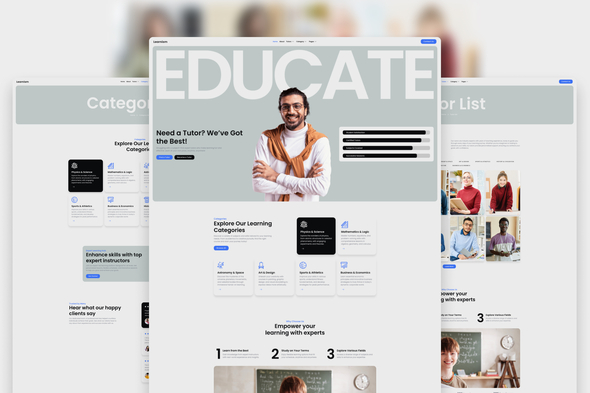
Building an online education platform demands a confluence of robust functionality and an intuitive, engaging user interface. Many project managers and web developers grapple with striking this balance, often resorting to custom development or trying to force a generic theme into a specialized role. This is where a targeted solution like Learnism - Professional Online Courses Elementor Template Kit steps in, promising a streamlined path to a professional-grade online learning environment. From a senior web developer's perspective, such template kits offer a significant head start, but the real value lies in their underlying structure, customization flexibility, and their suitability for real-world application.
Upon initial inspection, Learnism presents itself with a clean, modern aesthetic, immediately suggesting a professional and organized learning environment. The design language emphasizes clarity, spaciousness, and a user-centric approach, which are critical for educational platforms where information hierarchy and content readability are paramount. This kit is clearly aimed at individual educators, small to medium-sized educational institutions, coaching centers, and anyone looking to launch an online course marketplace without the astronomical costs and development time associated with bespoke design.
The kit promises a comprehensive set of templates for essential pages: a compelling home page, detailed course listings and individual course pages, instructor profiles, a blog section, and standard contact and about pages. What stands out early is the consistent design across these elements, which is a good indicator of a well-thought-out kit. However, as with any template solution, the critical question remains: how well does it integrate with the dynamic, often complex, requirements of an actual Learning Management System (LMS)? A template kit primarily provides the visual layer, and while Learnism excels in this, its true utility depends on how seamlessly it can be "hooked" into a backend LMS like LearnPress, Sensei, or LifterLMS.
Learnism’s design is characterized by a minimalist yet engaging approach. The color palette typically leans towards cool, professional tones — blues, grays, and whites often accented with a vibrant highlight color. This choice is deliberate, creating an atmosphere conducive to learning, reducing visual fatigue, and maintaining a high level of readability. Typography is well-selected, often combining a clean sans-serif for body text with a more distinctive serif or display font for headings, providing visual interest without sacrificing clarity.
The layout structures are predominantly grid-based, which aids in organizing large amounts of information – a common challenge on course platforms. Hero sections are impactful, leveraging large imagery or video backgrounds with concise calls to action. Course cards are well-designed, displaying key information such as course title, instructor, rating, and price in an easily scannable format. Single course pages feature dedicated sections for curriculum, instructor details, reviews, and related courses, all presented logically.
From a responsive design standpoint, the templates hold up well across various breakpoints. Elementor's inherent responsiveness is a strong foundation, and Learnism's layouts appear to have been optimized to ensure content remains legible and interactive on mobile devices. Navigation menus transform appropriately, and columnar layouts stack gracefully. This is not a trivial point; a significant portion of online learners access content via mobile, and a substandard mobile experience can severely hinder engagement and completion rates.
My only slight criticism regarding the design would be a potential lack of strong brand personality out-of-the-box. While "clean" and "professional" are excellent starting points, some users might find it a bit generic without significant customization. This isn't necessarily a flaw, but rather an expectation for users to invest time in personalizing the kit's global styles, fonts, and imagery to truly reflect their brand identity. The kit provides the skeleton; the user provides the soul.
As an Elementor Template Kit, Learnism naturally leverages Elementor's drag-and-drop interface and its array of widgets. The kit relies heavily on Elementor Pro for its advanced features, particularly Theme Builder functionalities for headers, footers, and dynamic templates for course archives and single course pages. This is an important distinction: while Elementor Free provides the core editor, Elementor Pro unlocks the true power required to implement a fully functional theme-level design with this kit.
The templates are structured using Elementor sections, inner sections, and columns, adhering to standard Elementor best practices. Widgets used are primarily native Elementor widgets (e.g., Heading, Text Editor, Image, Icon List, Button, Progress Bar, Testimonial, Posts, Price List) with thoughtful application. There doesn't appear to be an over-reliance on obscure third-party Elementor add-ons, which is a significant advantage. This minimizes potential compatibility issues and ensures long-term stability.
Global styles are effectively utilized for typography and colors. This is crucial for rapid customization. Modifying the global primary color, for instance, updates it across all templates that use that global variable, saving countless hours compared to editing individual element styles. The kit also includes global custom CSS where necessary, often for subtle design enhancements that go beyond what Elementor's style options provide directly. A developer can appreciate this detail, as it shows a commitment to polished design without adding unnecessary complexity.
Performance implications are always a concern with Elementor. While Elementor itself can be resource-intensive, a well-built kit minimizes bloat. Learnism appears to be reasonably optimized in its structure, avoiding excessive nesting of sections or redundant elements. However, the ultimate page load speed will depend heavily on the user's hosting environment, image optimization practices, and the efficiency of the chosen LMS plugin. A template kit is purely presentation; the performance overhead of the underlying WordPress and LMS infrastructure will always be the dominant factor.
The kit uses Elementor's "loop" templates for course listings, meaning it's designed to dynamically pull content from custom post types (which an LMS typically uses for courses). This dynamic content capability is the bridge between the template's design and the LMS's data. Understanding how to connect Elementor's dynamic tags to your LMS's custom fields is key to fully realizing the kit's potential beyond static design.
While Learnism is a template kit and not an LMS itself, it provides the necessary visual scaffolding to present LMS-driven content beautifully. It features dedicated layouts for:
The strength here is that the kit anticipates the typical data points an LMS would generate. For instance, the course overview sections include placeholders for course duration, number of lessons, difficulty level, and student count. When integrating with an LMS, these placeholders would be replaced by dynamic data tags pulling information directly from the LMS custom fields. This foresight makes the integration process smoother than starting with a completely generic template.
The kit does not include any specific LMS plugin functionality or widgets. This is standard for Elementor template kits. It provides the visual "skin" for your LMS. Therefore, users must be prepared to install and configure an LMS plugin (e.g., LearnPress, Tutor LMS, Sensei, LifterLMS) separately. The user will then need to either configure their chosen LMS to output its content using Elementor's Theme Builder templates (which Learnism provides) or carefully map Elementor dynamic fields to the LMS's custom fields. This is where the "senior web developer" hat comes on; it requires a solid understanding of both Elementor Pro's dynamic capabilities and the chosen LMS's architecture.
Deploying an Elementor Template Kit, especially one as comprehensive as Learnism, requires a methodical approach. This isn't just about uploading files; it's about configuring your WordPress environment to effectively use the templates.
After acquiring the Learnism Template Kit, you'll receive a .zip file. Download this file to your computer. Do not unzip it yet. Elementor's kit importer expects the original .zip file.
If you haven't already, install and activate the free Elementor plugin from your WordPress dashboard (Plugins > Add New). Then, upload and activate your Elementor Pro plugin. Ensure your Elementor Pro license is activated under Elementor > License.
This is a crucial step for many template kits not sourced directly from Elementor's official library. Go to Plugins > Add New and search for "Template Kit Import" (by Envato Elements). Install and activate this plugin. This plugin facilitates the correct import of .zip template kits.
Crucial Note: Always import Site Settings first, as this establishes the global styling that the individual page templates rely on. If you import templates first, you might see incorrect fonts or colors.
After the import, navigate to Elementor > Site Settings. Review the imported Global Colors and Global Fonts. Adjust them to match your brand identity. Also, check other settings like Layout, Typography, Buttons, Image, Form Fields, and Custom CSS. This is where you personalize the kit's foundation.
This is the most complex step and is highly dependent on your chosen LMS. The Learnism kit provides template designs for single courses and course archives. You'll need to configure your LMS to output its course content through Elementor's Theme Builder templates. For example, with Elementor Pro, you can create a "Single Post" template (or "Single Course" if your LMS registers a custom post type) and design it using the Learnism styling. You'd then use Elementor's dynamic tags to pull in the course title, content, instructor details, curriculum, etc., directly from your LMS's data.
This often involves:
Learnism - Professional Online Courses Elementor Template Kit is a powerful asset for anyone looking to quickly deploy a visually appealing and highly functional online learning platform using WordPress and Elementor. It excels at providing a professional, clean, and responsive design foundation that thoughtfully anticipates the needs of educational content.
From a senior web developer's perspective, this kit is an excellent starting point, saving hundreds of hours on design and frontend development. However, it's crucial for users to understand that this is a *design template kit*, not a full LMS solution. The heavy lifting of integrating with a robust Learning Management System, configuring dynamic content, and ongoing site optimization will still fall to the implementer.
I recommend Learnism highly for:
It’s not for those expecting an all-in-one, plug-and-play LMS. But for those ready to combine a solid design with a powerful backend, Learnism provides a compelling proposition. For other excellent resources, you might explore the wider range offered by gplpal, a valuable hub for web development assets. Their selection includes many useful items that can complement a robust online presence. Consider browsing their Free download WordPress themes and plugins to enhance your projects.