---
# System prepended metadata

title: 'Dissecting Yoda: A Technical Review and Installation Guide for the Bootstrap 5, Vue, and React Admin Dashboard Template '

---

<h1>Dissecting Yoda: A Technical Review and Installation Guide for the Bootstrap 5, Vue, and React Admin Dashboard Template</h1>

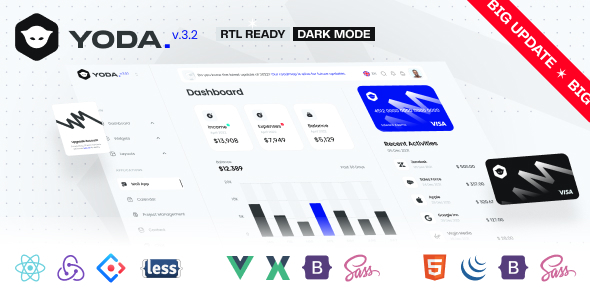
<p>The admin dashboard landscape is saturated, yet every so often, a template package emerges attempting to streamline development across multiple front-end paradigms. Today, we're dissecting <a href="https://gplpal.com/product/yoda-bootstrap-5-html-vue-react-admin-dashboard/">Yoda - Bootstrap 5 HTML, Vue, React Admin Dashboard Template</a>. This offering promises a unified design system delivered in three distinct technology stacks: a plain HTML/Bootstrap 5 variant, a Vue.js implementation, and a React.js version. As a senior web developer, my interest lies not just in the aesthetic polish, but in the underlying architecture, developer experience, and the real-world viability of such a multi-framework approach. The core challenge for any template of this nature is maintaining consistency and quality across disparate ecosystems while providing genuine value beyond what a developer could assemble from scratch. This review will delve into these aspects, followed by a practical installation and initial setup guide for each version.</p><p><img src="https://s3.us-east-005.backblazeb2.com/gplpal/2026/03/01-thumbnail.__large_preview.jpg" alt="Yoda - Bootstrap 5 HTML, Vue, React Admin Dashboard Template Unlimited Sites"></p>

<h2>First Impressions and Architectural Overview</h2>

<p>Upon initial inspection, Yoda presents a clean, modern aesthetic. The design language is contemporary, favoring soft shadows, subtle gradients, and a clear typographic hierarchy – a welcome departure from some of the overly cluttered or garish dashboards of yesteryear. Responsiveness appears well-handled, which is a non-negotiable for any modern web application. The core promise of Yoda is flexibility: offering the same UI components and page layouts in HTML, Vue, and React. This immediately raises questions about maintainability and the depth of integration within each framework. A superficial wrapper around Bootstrap components in Vue or React adds little value; true integration leverages the framework's reactivity, component lifecycle, and state management patterns.</p>

<p>The overall architecture, therefore, isn't a single monolithic project but rather three separate projects bundled together. This is the only pragmatic approach for multi-framework templates. Each project maintains its own dependencies, build process, and specific framework conventions. While this ensures idiomatic code within each stack, it also means that the developer buying Yoda isn't getting a 'universal' codebase. Instead, they are choosing one specific version to proceed with, effectively paying for two other versions they might not use. This isn't inherently a flaw, but an important distinction for project managers assessing licensing and developer skill sets.</p>

<h2>Deep Dive: The HTML/Bootstrap 5 Version</h2>

<p>The HTML/Bootstrap 5 version serves as the foundational blueprint for the entire Yoda package. It leverages Bootstrap 5's utility-first classes, modern grid system, and a component library that has matured significantly. For developers who prioritize speed of deployment and have minimal front-end interactivity requirements beyond what Bootstrap's JavaScript components (dropdowns, modals, carousels) offer, this version is a strong contender.</p>

<h3>Strengths:</h3>
<ul>
    <li><strong>Bootstrap 5 Native:</strong> Fully embraces Bootstrap 5, meaning developers familiar with the framework can hit the ground running. Customization through Sass variables is straightforward, allowing for deep branding changes without touching raw CSS.</li>
    <li><strong>SASS Integration:</strong> The template includes Sass files, indicating a proper development workflow for styling. This allows for theme modifications, color palette adjustments, and component overrides in a structured manner, rather than wrestling with inline styles or specificity issues.</li>
    <li><strong>Ease of Customization (for static content):</strong> For static pages or dashboards where dynamic data rendering is handled server-side, modifying content and layout is as simple as editing HTML files. No complex build chains or component logic to untangle.</li>
    <li><strong>Performance:</strong> Being primarily HTML and CSS, and relying on minimal JavaScript (mostly Bootstrap's own), this version tends to be the lightest and fastest to load, assuming good asset optimization.</li>
</ul>

<h3>Weaknesses:</h3>
<ul>
    <li><strong>Limited Reactivity:</strong> By its nature, this version lacks the powerful reactivity and state management capabilities of Vue or React. Implementing dynamic updates, complex forms with real-time validation, or interactive data visualizations requires integrating additional JavaScript libraries and writing custom DOM manipulation code, which can quickly lead to an unmanageable codebase.</li>
    <li><strong>jQuery Dependency:</strong> While Bootstrap 5 has significantly reduced its reliance on jQuery, some legacy components or third-party plugins might still pull it in. Modern front-end development increasingly moves away from jQuery, and its presence can feel dated to developers accustomed to vanilla JavaScript or framework-specific solutions.</li>
    <li><strong>Scalability Concerns:</strong> For applications destined to grow in complexity, the lack of a component model or structured state management can become a significant bottleneck. Large HTML files with repetitive structures become difficult to maintain and extend.</li>
</ul>

<p><strong>Target Use Case:</strong> This version is ideal for static dashboards, rapid prototyping, marketing administration panels, or any project where the backend renders most of the dynamic content and the front-end merely serves as a presentational layer. Projects with experienced backend developers handling the bulk of the logic, or those on tight deadlines requiring a quick visual refresh, will find value here.</p>

<h2>Deep Dive: The Vue.js Version</h2>

<p>The Vue.js version positions Yoda within one of the fastest-growing and most developer-friendly front-end frameworks. Vue's progressive adoptability makes it appealing for projects of varying scales. A good Vue implementation of a template should leverage its component system, reactivity, and potentially its ecosystem for routing and state management.</p>

<h3>Strengths:</h3>
<ul>
    <li><strong>Component-Based Architecture:</strong> Vue naturally lends itself to breaking down UI into manageable, reusable components. A well-structured Yoda Vue project should allow developers to easily compose pages from these building blocks, promoting maintainability and scalability.</li>
    <li><strong>Reactivity:</strong> Vue's core strength lies in its intuitive reactivity system. Data changes automatically reflect in the UI, simplifying the development of dynamic interfaces without manual DOM manipulation.</li>
    <li><strong>Vue CLI Integration:</strong> Assuming it's built with Vue CLI, developers benefit from a robust development environment, hot module replacement, and optimized production builds.</li>
    <li><strong>State Management (Vuex/Pinia):</strong> A serious Vue admin template should integrate a state management solution like Vuex or Pinia for global state. If included, this demonstrates a mature understanding of building scalable Vue applications.</li>
    <li><strong>Routing (Vue Router):</strong> Essential for single-page applications, Vue Router handles navigation cleanly, allowing for dynamic routes and nested views.</li>
</ul>

<h3>Weaknesses:</h3>
<ul>
    <li><strong>Learning Curve:</strong> While considered more approachable than React by many, developers new to Vue will still face a learning curve regarding component lifecycles, reactivity, and toolchain.</li>
    <li><strong>Boilerplate:</strong> Depending on the implementation, there can be a fair amount of boilerplate code, particularly if Vuex and Vue Router are extensively used. This is often a trade-off for maintainability in larger applications.</li>
    <li><strong>Potential for Shallow Integration:</strong> The risk here is a Vue version that simply wraps Bootstrap components without fully leveraging Vue's capabilities. If components are merely HTML snippets within a <code>.vue</code> file with minimal props or state, much of Vue's power is underutilized.</li>
</ul>

<p><strong>Target Use Case:</strong> This version is well-suited for single-page applications (SPAs), complex dashboards requiring heavy data interaction, or projects where developer productivity and a gentle learning curve are priorities. Teams already invested in the Vue ecosystem will find this a familiar and efficient starting point.</p>

<h2>Deep Dive: The React.js Version</h2>

<p>The React.js version of Yoda caters to the most dominant front-end framework today. A robust React template should embrace JSX, functional components with Hooks, and integrate seamlessly with React's vast ecosystem for routing and state management.</p>

<h3>Strengths:</h3>
<ul>
    <li><strong>Component-Based Architecture:</strong> Like Vue, React excels at component composition. A well-designed React version of Yoda provides reusable, self-contained UI units, leading to modular and understandable code.</li>
    <li><strong>JSX and Functional Components with Hooks:</strong> Modern React development heavily relies on functional components and Hooks. An up-to-date template should reflect this, offering a contemporary React development experience.</li>
    <li><strong>Create React App (CRA) or Vite Integration:</strong> Utilizing CRA or Vite ensures a standardized development setup, hot reloading, and optimized builds.</li>
    <li><strong>State Management (Context API/Redux):</strong> For larger React applications, a state management solution (Context API, Redux Toolkit, Zustand, etc.) is crucial. Its inclusion signifies an understanding of managing application state effectively.</li>
    <li><strong>Routing (React Router):</strong> Seamless navigation for SPAs is provided by React Router, a standard in the React ecosystem.</li>
</ul>

<h3>Weaknesses:</h3>
<ul>
    <li><strong>Initial Setup Complexity:</strong> While CRA simplifies much, React's ecosystem can feel more complex to beginners than Vue's, particularly when diving into build tools, state management libraries, and various patterns.</li>
    <li><strong>"Prop Drilling":</strong> Without careful planning or adequate state management, passing props down through many layers of components (prop drilling) can become tedious and reduce code clarity.</li>
    <li><strong>Opinionated Approach:</strong> React's flexibility means there are often multiple ways to achieve the same outcome. The template's chosen patterns (e.g., component structure, styling approach) might not align perfectly with an existing team's conventions, requiring adaptation.</li>
    <li><strong>Performance Overhead:</strong> React's virtual DOM, while efficient, does introduce some overhead compared to vanilla HTML. Optimizing renders and bundle size is crucial for large applications.</li>
</ul>

<p><strong>Target Use Case:</strong> This version is ideal for large-scale enterprise applications, complex SPAs, or projects where the development team has significant React expertise. It's a solid choice for companies committed to the React ecosystem and its rich library of tools and community support.</p>

<h2>Common Features and Component Quality Across Versions</h2>

<p>Beyond the framework-specific implementations, a template's value is also defined by its core offerings that transcend the underlying technology. Yoda generally maintains a consistent visual identity across its versions, which is commendable given the challenges of translating design across frameworks.</p>

<h3>UI/UX Consistency and Responsiveness:</h3>
<p>The design remains largely consistent, providing a unified user experience regardless of the chosen technology stack. The responsiveness holds up well on various screen sizes, which is fundamental for any modern web application accessible across devices. The dashboard layouts adapt gracefully, and key navigation elements remain usable on mobile. This indicates a strong foundation in Bootstrap's responsive utilities and careful consideration in the framework implementations.</p>

<h3>Charts & Data Visualization:</h3>
<p>Modern admin panels live and die by their ability to present data effectively. Yoda includes integrations with popular charting libraries like Chart.js or ApexCharts (depending on the exact implementation details, templates often choose one or the other, or offer both). The quality of chart examples — their responsiveness, interactivity, and ease of data binding — is a critical factor. For a template, pre-configured chart components that accept data as props (in Vue/React) or through simple JavaScript functions (in HTML) significantly reduce development time.</p>

<h3>Forms & Tables:</h3>
<p>These are the workhorses of any admin interface. Yoda provides well-styled forms with various input types, validation examples, and perhaps even multi-step forms. Advanced tables with features like pagination, sorting, filtering, and in-line editing are invaluable. The quality here is judged by the robustness of these features and how easily they can be hooked up to a backend API. For Vue/React, this means well-encapsulated components that expose clear props and events.</p>

<h3>Pre-built Pages:</h3>
<p>The inclusion of common pages such as login, registration, profile settings, user management, error pages (404, 500), and pricing tables is a significant time-saver. These pages often require specific layouts and component arrangements that are tedious to build from scratch. Yoda provides a good selection, and their reusability across frameworks is a core benefit.</p>

<h3>Customization:</h3>
<p>All versions should offer sensible customization points. For the HTML/Bootstrap version, this primarily revolves around Sass variables for colors, typography, and spacing. For Vue and React, this extends to props for individual components, global theme providers (if implemented), and the ability to easily swap out or augment components with custom ones. The template's support for dark mode, if present, is a powerful feature that users increasingly expect.</p>

<h2>Documentation and Support</h2>

<p>The value of any template is severely diminished without clear, comprehensive documentation. Developers spend more time reading documentation than they care to admit. Effective documentation for Yoda should include:</p>
<ul>
    <li><strong>Getting Started Guides:</strong> Step-by-step instructions for initial setup for each framework.</li>
    <li><strong>Project Structure Explanation:</strong> A clear map of the folders and files, explaining the purpose of key directories (e.g., <code>src/components</code>, <code>src/views</code>, <code>src/router</code>).</li>
    <li><strong>Component Reference:</strong> A catalog of all available UI components with their props, slots/children, and usage examples.</li>
    <li><strong>Customization Guide:</strong> How to change themes, colors, fonts, and extend functionality.</li>
    <li><strong>Deployment Instructions:</strong> How to build for production and deploy to common hosting environments.</li>
</ul>
<p>Without solid documentation, developers waste valuable time reverse-engineering the template's structure and conventions. The quality of documentation for a multi-framework product needs to be particularly high, catering to developers who might be proficient in one framework but new to another.</p>

<h2>Performance Considerations</h2>

<p>Performance is often an afterthought with templates, but it shouldn't be. Heavy templates with excessive dependencies, unoptimized assets, or poor code-splitting can lead to slow load times and a poor user experience. While Bootstrap itself is relatively lean, adding a framework (Vue/React), charting libraries, and other UI components can quickly inflate bundle sizes.</p>
<p>A good template should demonstrate:
<ul>
    <li><strong>Optimized Production Builds:</strong> Minified and gzipped assets, tree-shaking, and code-splitting are essential for modern web applications.</li>
    <li><strong>Lazy Loading:</strong> Implementations of lazy loading for routes or large components in Vue/React versions can significantly reduce initial load times.</li>
    <li><strong>Efficient Asset Management:</strong> Proper handling of images, fonts, and icons to minimize requests and file sizes.</li>
</ul>
Developers adopting Yoda should always run Lighthouse audits or similar performance checks after integrating their content, as the baseline template performance can change dramatically with added features.</p>

<h2>Real-world Applicability and Use Cases</h2>

<p>Yoda, with its multi-framework offering, attempts to cast a wide net. It is most applicable in scenarios where:</p>
<ul>
    <li><strong>Rapid Prototyping:</strong> The pre-built pages and components allow for quick assembly of functional mock-ups.</li>
    <li><strong>Internal Tools:</strong> Admin panels, CRM dashboards, analytics platforms, or other internal business applications where a polished UI is desired without a full design cycle.</li>
    <li><strong>Startup MVPs:</strong> For startups needing to launch a product quickly with a professional-looking backend, Yoda can save considerable development time.</li>
    <li><strong>Teams with Mixed Skill Sets:</strong> If a development team has members proficient in different frameworks, Yoda allows them to work within their preferred stack while maintaining a consistent visual identity across different sub-projects.</li>
</ul>

<p>It might struggle in highly unique branding requirements that demand a complete departure from Bootstrap's conventions, or in applications with extremely specific performance demands that necessitate a bespoke, hyper-optimized front-end build.</p>

<h2>Critique and Areas for Improvement</h2>

<p>While Yoda offers a solid foundation, there are always areas for critical observation:</p>
<ul>
    <li><strong>Framework-Specific Idioms:</strong> The primary critique for any multi-framework template is the depth of integration. Does the React version truly feel like a React app, leveraging custom Hooks and Context, or is it a thin wrapper around Bootstrap? Similarly for Vue, does it fully embrace options/composition API patterns and reactive principles? Often, these templates prioritize visual consistency over idiomatic framework code, leading to a less-than-optimal developer experience.</li>
    <li><strong>Versioning and Updates:</strong> How frequently is the template updated? Given the rapid evolution of Bootstrap, Vue, and React, keeping all three versions current with the latest best practices and dependencies is a significant undertaking. Outdated dependencies can introduce security vulnerabilities or compatibility issues.</li>
    <li><strong>Theming System:</strong> While Sass variables provide customization, a more advanced theming system (e.g., CSS variables, ThemeProvider for React, or a Vue plugin for theming) could offer greater flexibility and dynamic theme switching with less effort.</li>
    <li><strong>Accessibility:</strong> A thorough review of accessibility standards (ARIA attributes, keyboard navigation, contrast ratios) is crucial for any professional template. This is often overlooked in favor of visual appeal.</li>
    <li><strong>Testing:</strong> The inclusion of basic unit or integration tests (especially for Vue/React components) would significantly enhance developer confidence and reduce the likelihood of regressions during customization.</li>
</ul>

<p>Overall, Yoda serves its purpose as a comprehensive admin template package. Its value proposition lies in providing a head-start across different front-end technologies. Developers must, however, choose their preferred framework carefully, as the commitment is to one specific version, not a magically convertible codebase.</p>

<h2>Installation Guide: Getting Started with Yoda</h2>

<p>This guide will walk you through setting up each version of the Yoda dashboard template. You'll need some basic prerequisites in place.</p>

<h3>General Prerequisites:</h3>
<ul>
    <li><strong>Node.js:</strong> Ensure you have Node.js installed (LTS version recommended). You can download it from <a href="https://nodejs.org/">nodejs.org</a>.</li>
    <li><strong>npm (Node Package Manager) or Yarn:</strong> npm comes bundled with Node.js. Yarn can be installed via <code>npm install -g yarn</code>.</li>
    <li><strong>Code Editor:</strong> Visual Studio Code is highly recommended.</li>
    <li><strong>Basic Terminal/Command Line Knowledge:</strong> You'll be using commands like <code>cd</code>, <code>npm install</code>, etc.</li>
</ul>

<p>After purchasing and downloading Yoda from <a href="https://gplapl.com/">gplpal</a>, extract the zipped archive to a directory of your choice. You will typically find three main folders inside: <code>html</code>, <code>vue</code>, and <code>react</code>, corresponding to each version.</p>

<h3>1. Installing the HTML/Bootstrap 5 Version</h3>

<p>The HTML version is the most straightforward as it doesn't require a complex build process for basic usage. However, for Sass compilation and asset management, it often utilizes build tools like Gulp or Webpack.</p>

<h4>Steps:</h4>
<ol>
    <li><strong>Navigate to the HTML directory:</strong>
        <pre><code>cd path/to/yoda/html</code></pre>
    </li>
    <li><strong>Install Dependencies:</strong> The HTML version might have a <code>package.json</code> file if it uses Sass compilation, JavaScript concatenation, or other development utilities. If so, install its dependencies:
        <pre><code>npm install</code></pre>
        or
        <pre><code>yarn install</code></pre>
        If there's no <code>package.json</code>, you can skip this step, but you'll be managing CSS/JS manually or using a separate Sass compiler.
    </li>
    <li><strong>Run Development Script (if available):</strong>
        If a <code>package.json</code> exists, there's usually a script to compile Sass and watch for changes. Look for a <code>start</code> or <code>dev</code> script.
        <pre><code>npm run dev</code></pre>
        or
        <pre><code>yarn dev</code></pre>
        This will typically open the dashboard in your browser and recompile assets on file changes.
    </li>
    <li><strong>Direct Access (if no scripts):</strong> If there are no build scripts, you can simply open any of the HTML files (e.g., <code>index.html</code>) directly in your browser. This is suitable for basic viewing, but for development with Sass, you'll need a separate compilation method.</li>
    <li><strong>Basic Customization:</strong>
        <ul>
            <li><strong>Colors/Theming:</strong> Modify the Sass variables (usually in a file like <code>_variables.scss</code> or <code>_custom.scss</code>) within the <code>src/scss</code> or <code>assets/scss</code> folder. After saving, your build script should recompile the CSS.</li>
            <li><strong>Content:</strong> Edit the HTML files directly to change text, add new sections, or modify layouts.</li>
            <li><strong>Add a New Page:</strong> Duplicate an existing HTML file, rename it, and modify its content. Ensure you update any navigation links to point to your new page.</li>
        </ul>
    </li>
    <li><strong>Build for Production:</strong> If a build script exists (e.g., <code>npm run build</code> or <code>yarn build</code>), run it to generate optimized, production-ready assets (minified CSS, JS).</li>
</ol>

<h3>2. Installing the Vue.js Version</h3>

<p>The Vue.js version will be set up as a standard Vue CLI project, providing a modern development workflow.</p>

<h4>Steps:</h4>
<ol>
    <li><strong>Navigate to the Vue directory:</strong>
        <pre><code>cd path/to/yoda/vue</code></pre>
    </li>
    <li><strong>Install Dependencies:</strong> The <code>package.json</code> file contains all the project's dependencies.
        <pre><code>npm install</code></pre>
        or
        <pre><code>yarn install</code></pre>
        This might take a few moments.
    </li>
    <li><strong>Run Development Server:</strong> Start the development server with hot module replacement.
        <pre><code>npm run serve</code></pre>
        or
        <pre><code>yarn serve</code></pre>
        This will typically start the server on <code>http://localhost:8080</code> (or another port) and automatically open it in your browser. Any changes you save will be reflected instantly.
    </li>
    <li><strong>Project Structure Overview:</strong>
        <ul>
            <li><code>src/</code>: Contains all your Vue source code.</li>
            <li><code>src/components/</code>: Reusable Vue components.</li>
            <li><code>src/views/</code> or <code>src/pages/</code>: Components that represent full pages or routes.</li>
            <li><code>src/router/</code>: Configuration for Vue Router (defines your application's navigation).</li>
            <li><code>src/store/</code>: If Vuex or Pinia is used, this contains your state management logic.</li>
            <li><code>src/assets/</code>: Static assets like images, fonts, icons.</li>
            <li><code>public/</code>: Static files that are copied directly to the build output.</li>
        </ul>
    </li>
    <li><strong>Basic Customization & Development:</strong>
        <ul>
            <li><strong>Modify Components:</strong> Open files in <code>src/components</code> or <code>src/views</code> to adjust their templates, scripts, or styles.</li>
            <li><strong>Add a New Route/Page:</strong>
                <ol>
                    <li>Create a new <code>.vue</code> file in <code>src/views/</code> (e.g., <code>MyNewPage.vue</code>).</li>
                    <li>Open <code>src/router/index.js</code> (or similar) and add a new route object to the <code>routes</code> array, linking to your new component.</li>
                    <li>Update your navigation component (e.g., sidebar) to include a <code>&lt;router-link&gt;</code> to your new route.</li>
                </ol>
            </li>
            <li><strong>Styling:</strong> Vue projects often use Sass or Less. Modify the relevant <code>.scss</code> or <code>.vue</code> style blocks. Global styles might be in <code>src/assets/scss/</code> or a similar location.</li>
        </ul>
    </li>
    <li><strong>Build for Production:</strong> When ready to deploy, create an optimized build.
        <pre><code>npm run build</code></pre>
        or
        <pre><code>yarn build</code></pre>
        This will generate a <code>dist/</code> folder containing all the static assets for deployment.</li>
</ol>

<h3>3. Installing the React.js Version</h3>

<p>The React.js version will typically be based on Create React App (CRA) or Vite, offering a well-defined development and build process.</p>

<h4>Steps:</h4>
<ol>
    <li><strong>Navigate to the React directory:</strong>
        <pre><code>cd path/to/yoda/react</code></pre>
    </li>
    <li><strong>Install Dependencies:</strong> Just like with Vue, the <code>package.json</code> holds the key.
        <pre><code>npm install</code></pre>
        or
        <pre><code>yarn install</code></pre>
        This is a crucial step and can take a minute or two.
    </li>
    <li><strong>Run Development Server:</strong>
        <pre><code>npm start</code></pre>
        or
        <pre><code>yarn start</code></pre>
        This command will typically open your React application in a new browser tab at <code>http://localhost:3000</code> (or another port). It includes hot-reloading for a smooth development experience.
    </li>
    <li><strong>Project Structure Overview:</strong>
        <ul>
            <li><code>src/</code>: Contains all your React source code.</li>
            <li><code>src/components/</code>: Reusable React components.</li>
            <li><code>src/pages/</code> or <code>src/views/</code>: Components that represent full pages or routes.</li>
            <li><code>src/routes/</code>: Configuration for React Router (if used).</li>
            <li><code>src/context/</code> or <code>src/redux/</code>: If state management (Context API, Redux) is implemented.</li>
            <li><code>src/assets/</code>: Static assets.</li>
            <li><code>public/</code>: Static files that are copied directly to the build output.</li>
        </ul>
    </li>
    <li><strong>Basic Customization & Development:</strong>
        <ul>
            <li><strong>Modify Components:</strong> Open <code>.js</code> or <code>.jsx</code> files in <code>src/components</code> or <code>src/pages</code> to adjust their JSX, logic, or styles.</li>
            <li><strong>Add a New Route/Page:</strong>
                <ol>
                    <li>Create a new component file (e.g., <code>MyNewPage.jsx</code>) in <code>src/pages/</code>.</li>
                    <li>Open <code>src/routes/index.js</code> (or similar) and add a new <code>&lt;Route&gt;</code> component within your <code>&lt;BrowserRouter&gt;</code> (or equivalent), linking to your new component.</li>
                    <li>Update your navigation component (e.g., sidebar) to include a <code>&lt;Link&gt;</code> from <code>react-router-dom</code> to your new path.</li>
                </ol>
            </li>
            <li><strong>Styling:</strong> React projects often use CSS modules, styled-components, or Sass. Look for <code>.module.css</code>, <code>.scss</code> files, or styled component definitions to adjust styles. Global styles might be in <code>src/index.css</code> or a specific theme file.</li>
        </ul>
    </li>
    <li><strong>Build for Production:</strong> When your application is ready, build it for deployment.
        <pre><code>npm run build</code></pre>
        or
        <pre><code>yarn build</code></pre>
        This command creates an optimized <code>build/</code> folder with all the minified and compressed assets, ready to be served by a static file host or web server.</li>
</ol>

<h3>Troubleshooting Common Issues:</h3>
<ul>
    <li><strong>&quot;command not found: npm/yarn&quot;:</strong> Ensure Node.js is installed correctly and its `bin` directory is in your system's PATH.</li>
    <li><strong>&quot;node-sass&quot; or &quot;sass&quot; compilation errors:</strong> This often relates to Node.js version compatibility or missing build tools. Try <code>npm rebuild node-sass</code> or ensure your Node.js version is compatible with the specified Sass library.</li>
    <li><strong>Dependency installation failures:</strong> Check your internet connection. Sometimes deleting <code>node_modules/</code> and <code>package-lock.json</code> (or <code>yarn.lock</code>) and running <code>npm install</code> again can resolve issues.</li>
    <li><strong>Port already in use:</strong> If the development server fails to start due to a port conflict, it will usually suggest an alternative. You can also manually kill processes using that port (e.g., <code>lsof -i tcp:3000</code> on Linux/macOS, then <code>kill -9 &lt;PID&gt;</code>).</li>
    <li><strong>Browser rendering issues after changes:</strong> Clear your browser cache or perform a hard refresh (Ctrl+Shift+R or Cmd+Shift+R). For framework versions, ensure the dev server is running and rebuilding correctly.</li>
</ul>

<h3>Advanced Customization and Development Workflow:</h3>
<p>Once the basic setup is complete, you'll likely want to integrate the dashboard with your own backend API. This typically involves using client-side HTTP libraries like Axios or the native Fetch API to make requests to your server endpoints. Managing authentication (tokens, sessions) and global state (user data, notifications) will be paramount for a real-world application.</p>
<p>For more specific needs, you might need to add additional third-party libraries (e.g., a richer date picker, a complex grid component). Always check the documentation of both Yoda and the new library for integration guidance. Maintain a disciplined approach to version control (Git) from the outset, committing changes regularly, especially when making significant modifications. Deployment strategies will vary widely depending on your infrastructure, but generally involve serving the production build (the <code>dist</code> or <code>build</code> folder) through a web server (Nginx, Apache) or a static hosting service (Netlify, Vercel, AWS S3).</p>
<p>Yoda provides a robust starting point, but the true value comes from a developer's ability to extend, customize, and integrate it into a cohesive application. The choice of HTML, Vue, or React will heavily dictate the subsequent development trajectory and the tooling involved. For those seeking other high-quality themes and plugins, a look through <a href="https://gplpal.com/shop/">Free download WordPress themes</a> on <a href="https://gplapl.com/">gplpal</a> could yield further resources.</p>