# HoughSpace
Explaing *Hough-Transform* for *line-space* and *curve-space*.
## 1. Hough transform for line
### 1.1 x-y Space
$f(x,y)$ => $y = ax + b$
which
* $a$: slope
* $b$: intercept
if we fixed $a = 0.5, b= 4.5$ , then
chart of $y = 0.5x + 4.5$ seems

(x,y) -> variable
(a,b) -> fixed
-> slope and intercept are fixed
-> fill **points**(Xn, Yn) inside the line bewteen the slope and the intercept
Summery:
Fixed **(a,b)**, you will get infinity **points** in the line
### 1.2 a-b Space
$g(a,b)$ => $b = -ax + y$
if we fixed $x = 0.5, y = 4.5$ , then
$b = -0.5a + 4.5$ , and
chart of $b = -0.5a + 4.5$ seems:

(slope = $-a/b$ = $tan($$\theta$$))$
(x,y) -> fixed
(a,b) -> variable
-> slope and intercept are mutable
-> fill(Rotate) **lines** where central point(strat point) fixed on (an,bn)
Summery:
Fixed **(x,y)**, you will get infinity **lines** on the point
### 1.3 Represent a-b Space with r-$\theta$ Space <br> aka Hough linear space
$h(r,$$\theta$$)$ => $r$ = $xcos($$\theta$$) + ysin($$\theta$$)$

if we mapping a linear eq.(a-b space) to r-$\theta$ space

### 1.4 Accumulator with r-$\theta$ Space

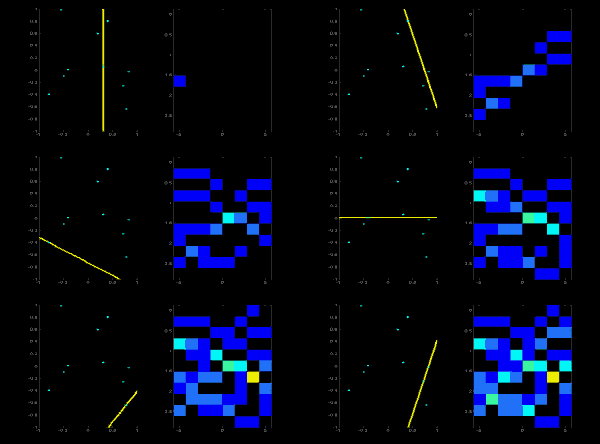
### 1.5 Summary: Flow of Hough Algorithm r-$\theta$ Space
1. Filtering input data or image(not found in paper)
2. Calculating (r,$\theta$) for each point which stayed after step 1
3. Choosing (r,$\theta$) with threshold
4. Rebuilding line with (r,$\theta$)
### 1.6 Naive implementation (python)
https://github.com/curly-wei/small-program/blob/master/python_training/hough/hough-line-space-2D.py

### 1.7 Or refer to here
https://docs.opencv.org/2.4/doc/tutorials/imgproc/imgtrans/hough_lines/hough_lines.html
## 2. Hough transform for curve
### 2.1 Explain
The curve of eq. in x-y space, we can express with
$(x-h)^2 + (y-k)^2 = r^2 ...eq.1$

If a center point of circuit at $(0,0)$,
then we can assume:
$h = r cos(t)$
$k = r sin(t)$
Substituting $r cos(t)$ and $r sin(t)$ into $(h,k)$ of $eq.1$,
we'll obtain:
$(x-r cos(t))^2 + (y-r sin(t))^2 = r^2 ...eq.2$
Arranging $eq.2$:
$r = \frac{1}{2} \frac{x^2 + y^2}{x cos(t) + y sin(t)} ...eq.3$
[Demo](https://www.youtube.com/watch?v=Ltqt24SQQoI):

Now,
assume that we have the eqution of circit $(x-0)^2 + (y-0)^2 = 5^2 ...eq.4$
its chart and some points:

We mapping
$f(x,y) -> g(t,r)$ where $t = rad. degree,$ $r=eq.3$
Using these points(above chart)
```
[0,5]
[3,4]
[5,0]
[0,-5]
[-4,-3]
```
plot $g(t,r)$ of $eq.4$
We get **error**(python with matplotlib, numpy, math)
``` bash
$ python ./hough-curve-space-2D.py
Traceback (most recent call last):
File "./hough-curve-space-2D.py", line 35, in <module>
theta
File "./hough-curve-space-2D.py", line 24, in get_hough_spcae
r_axis[i] = numerator / denominator
ZeroDivisionError: float division by zero
```
Because denominator of $eq.3$ is 0.
The denominator $x cos(t) + y sin(t)$ of $eq.3$ goes to **0** very easy,
for example:
{ `t = 0` **or** `x = 0` **or** `y = 0` }
But numerator not,
if the numerator $x^2 + y^2$ of $eq.3$ goes to **0**,
only the condition
{ `x = 0` **and** `y = 0` }
can be satisfied.
So we swap denominator and numerator from $eq.3$
$\frac{1}{r} = 2 \frac{x cos(t) + y sin(t)} {x^2 + y^2} ...eq.5$
### 2.2 Code demo
code:
https://github.com/curly-wei/small-program/blob/master/python_training/hough/hough-curve-spce-2D-1r.py
result:

###### tags: `TechReport` `DeWei` `2D`
 Sign in with Wallet
Connect another wallet
Sign in with Wallet
Connect another wallet