---
title: 'Ce nest ni un cœur ni de la chair 他不是心也不是肉'
tags: keywords
author: Tzu Tung Lee
link: https://hackmd.io/@BOTAMEVE/Keywords_LandingPage
---
## 1. Ce n'est ni un cœur ni de la chair 他不是心也不是肉

> _9cm length mark_, image by the aurthor.
Blood, or proliferating tissue — are these the messages trauma leaves behind?
My post-trauma days are like worn fingerprints, when fatigue, brain fog, and chronic pain take hold, they strip the vibrancy from life. Days turn dull and numb, and the edges blurred into a gray, unrecognizable landscape.
A friend who suffers from recurring ankle sprains once confided in me: his injury sends aches radiating through his entire body. To the casual observer, he appears healthy, savoring life as he slowly strolls down the street. Beneath that composed exterior, though, is suffering. His stiff, aching feet trace an unseen map of every uneven road, of each surface designed to inconvenience and distress those who traverse it.
**“The world’s been crippled.”**
Disability theory uses this phrase to describe the inversion of able-bodied norms. We live in a world built on ruggedness, sharp corners, frenetic pace, and imbalance. It demands that bodies maintain a facade of “ability,” deeming only the able-bodied fit to navigate its hostile terrain. Yet the truth is that every living being will encounter trauma, illness, aging, and various visible or invisible disabilities—bodies with disabilities are the norm, not the exception. Still, from the ethic of relentless productivity that is overly-hyped to roadways and infrastructure that ignore diverse physical needs, most of our world, shaped by the forces of capitalism, continues to prioritize unceasing output -- as if only the able-bodied can truly deliver and contribute to nations and societies.
During the global spread of COVID-19 in 2021 and 2022, the world opened a trapdoor, plunging the “able-bodied” into disarray—an environment eerily reminiscent of what happens when individual bodies become disabled. Movement was restricted, accessing information grew difficult, and isolation intensified. Frustration with institutional procedures surfaced, and a distinct, collective anger took shape. It offered a glimpse into what many disabled bodies feel routinely: a constant sense of inconvenience, as if basic fairness and justice have been quietly robbed away.
All that remained was retreating to the smallest, safest space one could still control. The world, originally built by able-bodied norms, rendered bodies useless and powerless. In the blink of an eye, everything changed. The dazzling facade of the capitalist world cracked, exposing its crippled essence beneath the glimmer of the Capitalocene.
_“I like this work of yours the most because it feels the most open.”_
This essay series took longer to finish than expected. It was originally due in September for the _[Keywords](https://keywordsart.com/)_ project, but illness delayed the process. As I navigated recovery while preparing for an exhibition at the Taipei Fine Arts Museum, _The Body's Tale of Vengeance and Mercy_ began to emerge.
Unlike works shaped by intellectual debates over design aesthetics or conceptual theory, this piece came instinctively — driven by something more visceral and deeply personal.
Conversations about trauma healing often revolve around familiar narratives of mending wounds and patching up broken souls. But these stories made me angry. After enduring frustration and mistreatment stemming from abuse of power in the realms of relationship, gender, and illness, I no longer wanted a simple fix. I rejected a sterile, scarless healing that merely covers and silences the pain. Instead, I craved something more—a mark etched deep, not just to heal, but to resist, to strike back, and to reclaim power, through revenge or through returning mercy.
_“Born toward death, being toward death.”_
It is a phrase rooted in Martin Heidegger’s existential philosophy, suggests that human existence is inherently oriented toward its own finitude. Trauma and illness accompany us throughout life, and if we are not careful, the endless waiting and hoping for healing can curdle into despair, leaving us passive and resigned.
I created _BOTAMEVE – The Body’s Tale of Mercy and Vengeance_ from this realization— it is a feminist fight club of sorts. In this place, I invited others to share their stories of bodily conflict with society: accounts of injustice rooted in gender, illness, disability, and hierarchical power structures. Together, we designed our curriculum, took classes, and eventually developed scripts for vengeance — ways to harness the weight of past suffering, to carve out a sharper, more calculated hope, and to strike back against systemic wrongs. Through these acts, we are also offering mercy and gratitude to our bodies, honoring their fragility and resilience.
The following essays includes my past essential experiences and practices that leads to the BOTAMEVE. They also include archival records of how BOTAMEVE is first exhibited from October 5 to November 11 2024 at a museum setting.
<details> <summary>中文</summary> 是血還是增生的組織,那一個是創傷後留下的訊息?
慢性的疲勞、遺忘、疼痛好像一切積極的世界正緩緩地向我遠去。日子像被磨平紋路的指頭,觸感變得遲鈍、迷糊,一且的邊界化作灰色、模糊而陌生的風景。
我與朋友訴苦,他也分享自己慢性腳踝扭傷至全身疼痛的經歷,外表健壯的他疼痛相對隱形,彷彿因享受生活走得特別慢,實際上正用僵硬腳掌的疼痛,鋪出一張台灣道路崎嶇不平的地圖,記錄每一寸顛簸地面對身體的折磨。
「這個世界是殘障的。」
在身心障礙理論中,這句話用來顛覆「健全」的概念。這個世界被架構得崎嶇、尖銳、快速又失衡,彷彿只有保持「健全」的假象,才能在這充滿敵意的環境裡繼續生存與生產。事實上,創傷、疾病、老化,以及各種有形或無形的障礙,才是人生的常態,而非例外。只是,在被資本主義塑造無止盡追求生產力、忽視多元身心狀態的世界裡,也預設了「只有健全的人才能持續為國家、社會與個人提供貢獻」。
在 2021、2022 年間,COVID-19 在全球蔓延,大批「健全」的人們被迫踏入近似身心障礙者的日常:行動受限、資訊取得困難、社會隔離加劇,並開始對各種制度性程序的不便與不公憤怒不已。那種被迫退回到僅能掌控的小小安全範圍、感覺自身無用且無力的體驗,正是許多身心障礙者原本就面對的處境。宛如在一瞬間,資本主義底下華美的假象破裂,露出它隱藏已久,只為了「健全者」而架設的殘缺的真相。
---
「我最喜歡你這個作品,因為它最開放。」
寫這篇文章的時間跨度很長,原本為九月為_[Keywords](https://keywordsart.com/)_ 交稿,因為生病而被迫延期,稍好時,又要在北美館展出作品,在試圖療癒、追上大家「生產力」的過程中,「酷殘陣線」出現了。比起使用腦袋琢磨設計美學及意義上的辯論,這個作品要怎麼做,很直覺。
人們說創傷療癒:身體修修補補、靈魂修修補補,在這個過程中,我產生了怒氣與恨意 --- 經歷了虐待關係、性別權力侵害以及慢性疾病上的挫敗、錯待,我所做的、所要的能否不只是修補? 既然人們是向死亡的方向活著,並與創傷與疾病時時相遇、一路前行。這些對於療癒的等待和希望若不小心,就會變成絕望的主題。
**「向死亡而生 (Born toward death, being toward death)。」**
這句源自馬丁.海德格(Martin Heidegger)的存在哲學,意指人的存在本質上便指向終結。我拒絕『復「原」』,我渴望的不只是重回『當初』,而是更深的刻痕—— 透過反擊或寬恕,去抵抗、聲張、奪回身體與心靈的權力來邁向死亡。
我組成「酷殘陣線」,一個女性主義格鬥俱樂部,我想聽見其他人分享身體扞格於社會時的經驗,那些身體所經歷的不正義 --- 從性別、疾病、身心障礙、權力位階... 然後共同發展一套復仇劇本:怎麼用曾經承擔的不義借力使力,利用既往苦難的沈重,在對抗系統性不公的同時,勾勒出更精準希望的拋物線。怎麼在對不義復仇的同時,對身體的脆弱與韌性報恩。
以下文章彙整了我在走向創作酷殘陣線之前的關鍵經驗與實踐,也記錄了酷殘陣線如何在 2024 年 10 月 5 日至 11 月 11 日首次於博物館形式中展出的檔案。
</details>
>
> _by TT_ [time=Thu, Dec 21, 2024 1:34 AM]
## 2. Daily 日常
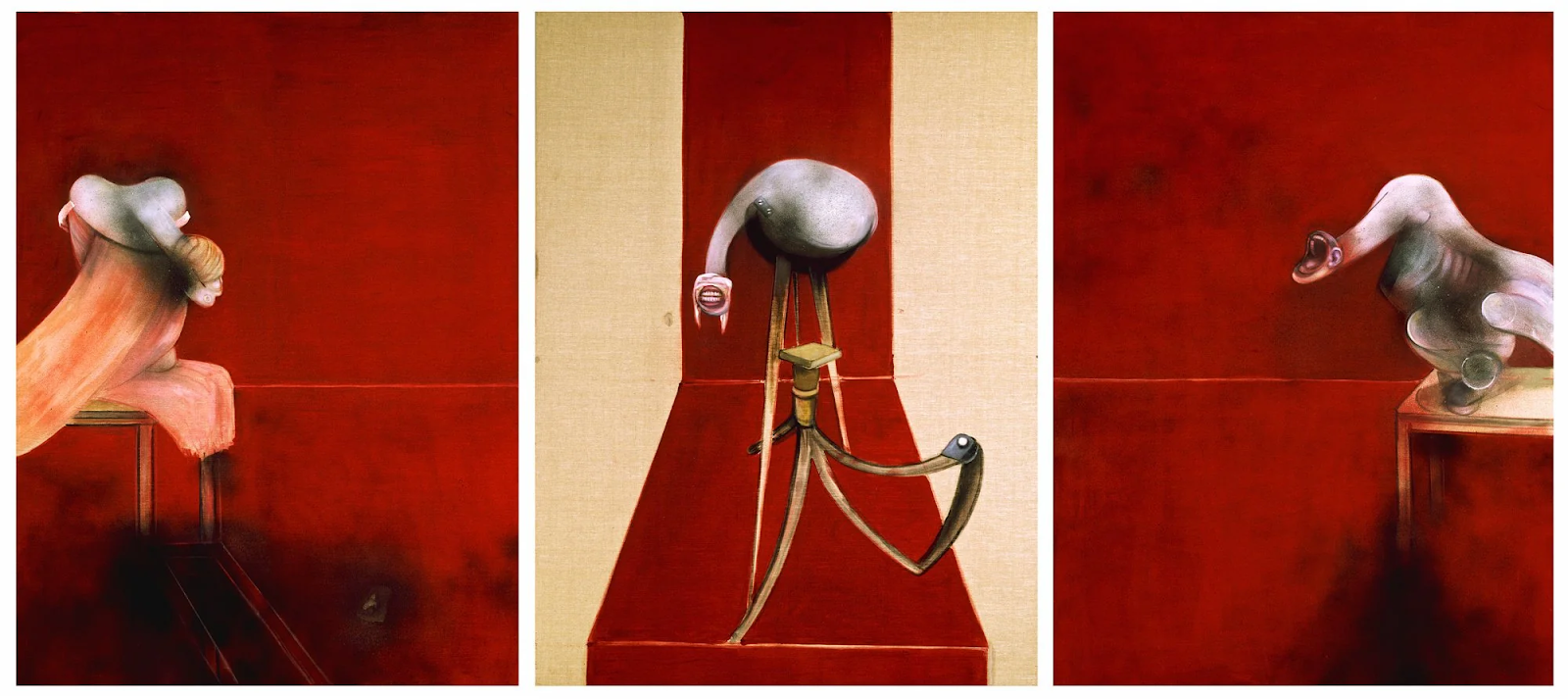
> _Second Version of Triptych 1944_ (1988), by Francis Bacon, Source: www.tate.org.uk, picture under <a href="//en.wikipedia.org/wiki/File:Second_Version_of_Triptych_1944.jpg" title="fair use">fair use</a>.
At the age of 34.
I find myself both intrigued and perplexed by how my younger self could have been so resolute in their ambitions —so radiant and driven. What disappoints me most is realizing that this 34-year-old version of me is simply human, a thoroughly confused being rather than a brilliant aspiration fulfilled.
In 2022 and 2023, two events consumed vast portions of my life: I encountered **her**, and the #MeToo movement erupted in Taiwan. She pursued me intensely, showering me with affection to the point that I willingly ignored the red flags. In that fervent rush — love-bombed and intoxicated by passion — I threw myself headlong into the relationship. As soon as I completed my second graduate degree, I decided to abandon my chance at an extended stay in the U.S. and return to Taiwan --- so I can keep the instense relationship going. She had told me that she lived alone, that I could stay with her. **15 seconds, or perhaps 10 seconds** -- that’s all it took for one to destroy the relationship.
After selling all my belongings in America and rushing back, I found myself weeping every single day in Taipei. The ambitious relationship dream had been betrayed,and I could no longer secure my sense of belonging, self-worth, or esteem.
Later, at Tate Britain in the U.K., I encountered Francis Bacon’s 1988 triptych. Though Bacon’s work tells its own story, what I saw was my own reflection -- seated in the “empty chair” of a therapist’s office. I witnessed myself trying to crawl free, only to remain trapped, trembling, and despairing. My shattered soul pieces were rigidly frozen -- as if becoming immovable wooden sculptures standing that suffers eternally in her living room.
<details> <summary>中文</summary> 34 歲。
覺得自己過去的能量怎麼那麼毅然又輝煌,我想我最失望的,便是,這個 34 歲的我竟然是一個「人」,我是一個「人」而不是一個輝煌的野心,我是一個徹徹底底迷惑的人。
2022 年與 23 年,對我發生兩件佔生命比例甚大的事:我遇見了**他**,以及 #Metoo 的爆發。他對我有熱烈的追求,這個過程中雖然偶然出現了些危險信號(red flag) ,但一切實在太過熱烈,我們瞬間就交往了,性也很熱烈,到我一念完研究所,便決定不待在美國立刻回台灣,他告訴我他的家現在一個人住了,過往,他一直說我可以去住他家。**15秒、或者10秒吧**,一個人在這麼短的時間內所做的行為,就可以毀掉一段關係。清空在美傢俱火速回台後,我便開始每天以淚洗面。一切都壞掉了。後來在英國泰特美術館(Tate Britain) 看到培根的三聯畫(1988)。培根有另一個他的故事,我看到的則是諮商室裡坐上「空椅」的自己,試圖爬行出來的又困住,抽搐、害怕、絕望、靈魂碎碎僵直如木頭雕刻,無法動彈佇立在他家客廳的模樣。</details>
>
>_by TT_[time=Thu, Aug 12, 2024]
## 3. Silence 沈默

> A private IG story published on May 24 2023, image by the author.
The #MeToo movement took root in Taiwan around May 2023, and the path to healing often feels like making three steps forward and two steps back.
After speaking out, my buried traumas surged to the surface, churning like water brought to a boil. In the past two years, I have seen the world as if through a ruptured retina—fragmented images stitched together from memories I tried to forget, layered beneath a narrative I forced myself to believe. Doubt weighs heavily and occurs repeatedly: Are my traumatic experiences real?
This year, I bled more than ever. Each month brought more bleeding, until doctors prescribed progesterone to control abnormal tissue growth in my uterus. I cannot help but suspect that my inner wounds are also bleeding beyond a metaphorical sense -- They are wordless injury as silent as the abuse itself.
“I’m fine.” “I’m okay.” My mouth never screams, instead it betrays me, it erases the evidence of my suffering. With no visible scars or bruises, surrounding family and friends saw only what they wanted to see: a smiling face, apparently unscathed. In a world where no knife is visible, the assumption is that the wounded person must be at fault. I, too, fell for this **victim-blaming** logic, desperately clinging to it for a semblance of cognitive coherence.
**Gaslighting** occurs when an abuser distorts reality until the victim doubts their own perceptions and memories. **Self-gaslighting** happens when victims internalize those distortions and continue undermining themselves. **Flying monkeys**, unwitting accomplices in the abuser’s narrative, help manipulate and attack survivors, often without realizing their own complicity. These are first few glossories for me to realize what have happened to me.
During the #MeToo movement, I faced attacks from the abuser’s circle and even a defamation lawsuit—a familiar tactic aimed at silencing those who speak out. It allows perpetrators to wield their power once more, transforming the legal system into yet another weapon against survivors and their allies.
Despite the attacks and lingering self-doubt, I’ve chosen to continue sharing my story because **I’ve witnessed these patterns of manipulation before**. Whether society blames women or those conditioned to internalize their suffering, the truth remains that harm has been woven into our collective fabric—passed down from generation to generation, nation to nation, and gender to gender. We must learn to recognize these subtle, invisible, and often intractable forms of abuse. They can manifest through relentless emotional pressure, distorted perceptions, and insidious blame-shifting, gradually eroding one’s sense of self. By identifying such elusive psychological tactics, we can begin to resist this soul-devouring dark magic and, ultimately, reclaim our own voices of truth—however slowly that process may unfold.
<details> <summary>中文</summary> 台灣的 #Metoo 約從 2023 年五月開始,而一切的療癒往往前進三步後退兩步。
在#Metoo 運動中發聲後,那些曾經歷的創傷經驗、也像水滾般泊泊翻濤上表層。我覺得我這兩年腦袋所見猶如透過破洞的視網膜,是四散的這一塊那一塊所拼湊出來:創傷後不願記憶的記憶、與堅持的自我敘事交疊。自我懷疑是最常湧現的質地:我的創傷是真的嗎?我還有能量創作嗎?我還有能量是我嗎?
過去這一年,我血流的特別多。每個月,血流的越來越多。後來檢查需要服用避孕藥也就是黃體素控制子宮內增生的腺體。--- 我懷疑我潛意識真的是流了那麽多血,因為我的內心也像被橫生的腺體般劃了一刀。
我未曾想過虐待原來如此沈默。
「我很好。」「我沒事。」我的嘴巴並不尖叫,我嘴巴都背叛了自己 --- 向他人抹去受苦的證據。沒有一道能向外界彰顯的疤痕瘀青,甚至,身邊的親朋好友長輩平輩,都只見得到也只願見到,那些運作正常滿臉堆笑的樣子。如果沒有明晃晃的刀子,卻有人受傷,那肯定是受傷的人做錯了什麼 --- 不管是他人、或是我自己,都相信了這種說法。
**煤氣燈(Gaslighting)** 是指施虐者通過扭曲現實,讓受害者對自己的記憶、感知或判斷產生懷疑,**自我煤氣燈(Self-Gaslighting)** 是指受害者內化了施虐者的操控行為,接續自我質疑、自我否定。**飛猴(Flying Monkey)** 則是許許多多施虐者的親朋好友、利害關係人,幫助操縱和攻擊受虐者,通常這些人未意識到自己也被施虐的敘事操控。
在#Metoo 運動裡,我曾受加害者的利害關係人與親朋好友攻擊,並被加害人告妨害名譽。妨害名譽是#Metoo 運動裡常用的噤聲手段,讓加害人再次利用權力優勢,將司法轉成壓迫倖存者或倖存者的支持者的工具。
這次我在受到攻擊、自我懷疑後,還是決定繼續說出故事。因為,我曾經歷相同的操縱情節。不管這個社會說是女生的錯、說是那個每次都自我煤氣燈的將關係裡的錯誤、社會的錯誤內化者的錯,現在,都要學會怎麼去辨認、抵禦,這吃人的黑魔法。. </details>
>
>_by TT_[time=Thu, Nov 10, 2024]
 Sign in with Wallet
Connect another wallet
Sign in with Wallet
Connect another wallet