# HTTP/2
---
### HTTP/2
* A take on improving on HTTP/1.1 downsides
* Mixed success: still uses TCP, does not always speed things up
* Designed to be interoperable with HTTP/1.1 (same message semantics)
* GRPC uses HTTP/2 as its main transport
---
| Aspect | HTTP/2 | HTTP/1.1 |
|--------|--------|----------|
| Encoding | Binary | Text |
| Headers | Compressed | Plain |
| Parallelism | Streams inside a connection^1^ | No^2^ |
| Prioritization and flow control | Yes^3^ | No^4^ |
| Server-pushed requests | Yes^5^ | No^6^ |
| Message cancellation | Yes | No^7^ |
----
#### Footnote 1: TCP in HTTP/2
HTTP/2 uses TCP, so a few lost/misordered/delayed packets in a TCP connection would slow down every in-flight request inside
This is why HTTP/2 does not always win in latency A/B tests
----
#### Footnote 2: Parallelism in HTTP/1.1
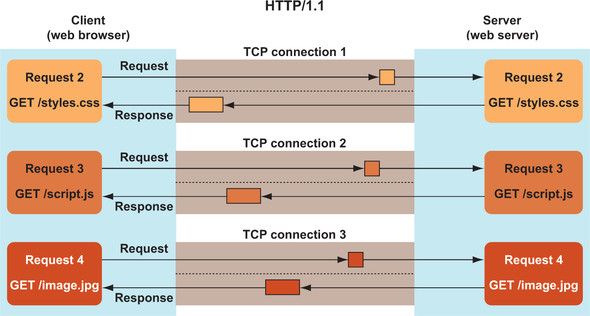
Parallelism in HTTP/1.1 can be achieved by opening multiple connections
Browsers have strict limits on how many TCP connections can be opened at once
These limits can be avoided by using multiple domains
----
#### Footnote 3: Prioritization in HTTP/2
The HTTP/2 standard defines a response prioritization mechanism
It is essential to web page load performance
Most real-world implementations do not fully implement the standard
----
#### Footnote 4: Prioritization in HTTP/1.1
Browsers prioritize downloads in HTTP/1.1 by choosing which resources to request and/or receive first
----
#### Footnote 5: Server-side pushes in HTTP/2
HTTP/2 server-side push mechanism is a part of the Web Push standard
Despite marketing it is mostly useless as a web page optimization
Some browsers have already deprecated it
Also, server-side pushes are not used in GRPC
----
#### Footnote 6: Ways to do server-side pushes
Ways to emulate server-pushed communication:
* Polling
* ServiceWorker Sync
* Long Polling
* Server Sent Events
* Websocket
* Web/Mobile Pushes
All these things can also be done in HTTP/2
----
#### Footnote 7: Cancelling a message in HTTP/1.1
Usually done by closing the TCP stream
This is why HTTP/2 TCP connections are much more long-lived than in HTTP/1.1
It means less TCP+TLS handshakes and avoiding the "slow-start" TCP mode
---
### Binary framing

---
### Streams, messages, and frames

---
### Header Compression

---
### Parallel requests in HTTP/1.1
---
### Same parallel requests in HTTP/2

---
### Server push

---
### Links
* ["High Performance Browser Networking"](https://hpbn.co/) book which I highly recommend as an introdution to the end-user networking perspective
* [RFC 7540](https://www.rfc-editor.org/rfc/rfc7540)
* [GRPC on HTTP/2](https://grpc.io/blog/grpc-on-http2/)
----
### Also used pictures from
* ["HTTP/2 In Action"](https://livebook.manning.com/book/http2-in-action/) book
* [HTTP/2 presentation by Ilya Gorelik](https://docs.google.com/presentation/d/1r7QXGYOLCh4fcUq0jDdDwKJWNqWK1o4xMtYpKZCJYjM/present)
{"metaMigratedAt":"2023-06-16T19:31:31.661Z","metaMigratedFrom":"YAML","title":"HTTP/2","breaks":true,"slideOptions":"{\"theme\":\"solarized\"}","contributors":"[{\"id\":\"e03327bd-87b7-4ac5-9cc2-2a66b2df58cf\",\"add\":7924,\"del\":6534}]"}