# 從實務上來講 CNN Pruning 到底在做什麼
#### 從 Fully Connected 講起
在一般的 FC layer 中, model pruning 並不是一件很難理解的事情,當我們想採用 structured pruning 時,直接針對 layer 中的 node 執行就好;unstructured pruning 時,我們就針對 weight 就好。
.
使用程式中的狀況來講,當我們有一個這樣子的網路:
```python=
fc1 = torch.nn.Linear(784, 32)
fc2 = torch.nn.Linear(32, 16)
classifier = torch.nn.Linear(16, 10)
```
我們將他的 weight 的形狀表示出來,分別是:
```python
fc1.weight.shape : (32, 784)
fc1.bias.shape : (32)
fc2.weight.shape : (16, 32)
fc2.bias.shape : (16)
classifier.weight.shape : (10, 16)
classifier.bias.shape : (10)
```
考慮到 structured prunin,我們將會同時處理掉 weight 中 dim=1 的部分、 bias 中 dim=0 的部分,如果我們 prune fc1 50% 的 weight,她會變成這樣:
```python
fc1.weight.shape : (16, 784)
fc1.bias.shape : (16)
```
當我們 fc1 的輸出變成 ==16== 維,下一層的輸入也會受到影響:
```python
fc2.weight.shape : (16, 16)
fc2.bias.shape : (16)
```
在 fc2 中,由 fc1 被 pruned 掉的部分所對應的 weight 也會被刪減掉。
在這個狀況下,我們會發現到:直接對結構處理是一件很麻煩的事,在 pyTorch 中,我們可以給 layer 設定一個 mask 來控制他最後出去的樣子
被 mask 掉的輸出將會被「歸零」,由此來模擬這個 weight / node 沒有輸出,我們重新考慮一個形狀為 (4, 3) 的 linear layer,我們分別以 structured pruning 與 unstrucutred pruning 來刪減掉 50%
```python
# structured pruning
module.weight.mask =
[
[1, 1, 1],
[1, 1, 1],
[0, 0, 0],
[0, 0, 0],
]
# mask[2, :] = 0
# mask[3, :] = 0
# unstructured pruning
module.weight.mask =
[
[1, 0, 1],
[0, 1, 0],
[1, 0, 1],
[0, 1, 0],
]
```
#### CNN 的 pruning
在 CNN 中,pruning 的方式又更多元了,主要有這三種方式:
1. Filter pruning
2. Channel pruning
3. Shape pruning
以及 unstructured pruning
不過,在提到 pruning 之前,要先回顧一下 CNN 是怎麼運作的
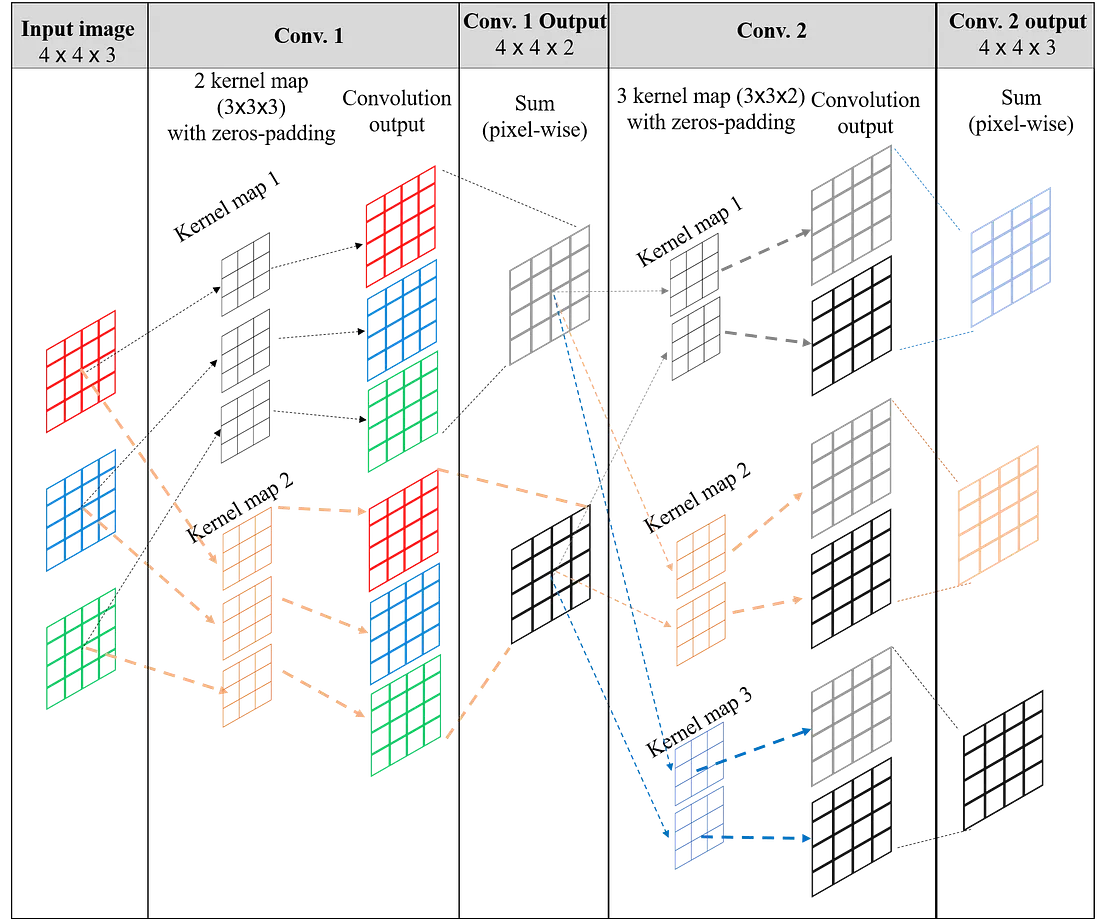[1]
可以看到我們的輸入是 (4, 4) 個 pixel,每個 pixel 有三個 channel。
第一層網路有 2 個 filter,每個 filter 有對應前一層輸入的 3 個 channel,每個 channel 的 kernel 為 (3, 3),
- 由此,我們的 conv2d 的形狀為 (2, 3, 3, 3)
- 第 0 維: filter 數量
- 第 1 維: channel 數量
- 第2 3維: kernel 的高寬
- 第 1 2 3 維就等於是一個 filter
我們在計算的時候,會先對每個 channel 進行捲機操作,然後把同個 filter 的 channel 捲機結果以 pixel-wise 的方式加起來。
- 套上例子,每個 filter 有 3 個 kernel,分別對前層(輸入層)的紅藍綠 3 個 channel 進行計算,接著將這三個捲積輸出加起來
- 由於我們有兩個 filter,最後會產出 2 張conv output,會作為下一層的 input channel 使用
當我們把他具象化出來後,我們就能很好的理解一開始提及的三種 pruning 方式在做什麼了
##### 1. Filter pruning:針對conv output 進行刪減
套用到上述例子
- 就是一次刪除 3 個 channel 的 kernel (在圖中表示為 kernel map)
- 當我們 prune 掉 1 個 filter,conv 的形狀為 (==1==, 3, 3, 3)
而在實務上,我們有兩個做法,與 FC 層的狀況相同,可以調整結構,變成(==1==, 3, 3, 3)
```python
# Before pruning
conv2d = torch.nn.Conv2d(in_channels=3, out_channels=2, kernel_size=3)
conv2d.shape : (2, 3, 3, 3)
# Apply pruning
# After pruning
conv2d.shape : (1, 3, 3, 3)
```
由於我們刪減了filter的數量,下一層的 in channel 也需要改變:
```python
# Before pruning
conv2d_2 = torch.nn.Conv2d(in_channels=2, out_channels=3, kernel_size=3)
conv2d_2.shape : (3, 2, 3, 3)
# After pruning
conv2d_2.shape : (3, 1, 3, 3)
```
第二個則是給他一個 mask
```python
mask : torch.ones( (2, 3, 3, 3) )
# Assume that we puring the filter index = 1
mask[1, :, :, :] = 0
Apply mask to conv2d
```
由於我們是加 mask,不再需要調整結構。
如此一來我們就能成功刪減 filter 了。
##### 2. Channel pruning
Channel 比較有趣,我們在上面提到了很多次 filter 中的 channel 數量,所以 channel pruning 就是刪減每個 filter 中固定的 channel
一樣拿上面的例子講,假設我們要刪除 1 個 channel,具體來說是希望刪除掉紅色 channel,我們的 conv 形狀會變成 (2, 2, 3, 3)
- 有 2 個 filter,每個 filter 有 2 個 channel (藍綠),每個 channel 的 kernel shape 為 (3, 3)
- 在計算 filter 時,我們針對 藍綠 兩個 channel 進行捲積計算,算出兩個捲積輸出後進行 pixel-wise 的加總
在實務上,如果要調整結構,整個操作會有點從後往前來。由於對輸入 $x$ 的處理比較特別,可以參考 2017 的 channel pruning 開山始祖 [2]
這裡讓我們刪除 conv2d_2 中的 index = 1 的 channel
```python
# Before pruning
conv2d = torch.nn.Conv2d(in_channels=3, out_channels=2, kernel_size=3)
conv2d.shape : (2, 3, 3, 3)
conv2d_2 = torch.nn.Conv2d(in_channels=2, out_channels=3, kernel_size=3)
conv2d_2.shape : (3, 2, 3, 3)
# Apply pruning
# After pruning
conv2d_2.shape : (3, 1, 3, 3)
# Adjust previous layer
conv2d.shape : (1, 3, 3, 3)
```
一樣我們可以採用 mask 的方式:
```python
mask : torch.ones( (3, 2, 3, 3) )
# Assume that we puring the channel index = 1
mask[:, 1, :, :] = 0
Apply mask conv2d_2
```
其實就只是套用的維度不同而已
##### 3. Shape pruning
Shape pruning 我覺得其實蠻少用的,不過簡單來講就是對 kernel 的特定 weight 調整
(其實這個我不太熟,不過以上面的來講,就是調整 kernel_size,套用mask 的話就是對 2 3 維設0)
##### Unstructure pruning
這個跟 FC layer 的時候一樣,對 mask 四維中任意元素設0
#### 總結
其實整體的困難在於 filter 與 channel 套用在具體的神經網路中的差異到底是什麼,由於計算涉及 pixel-wise sum,使用圖片示意刪減範圍可匯難以理解,所以這次是以神經網路實做的角度來講這件事,大概是這樣
[1] [卷積神經網路(Convolutional neural network, CNN): 1×1卷積計算在做什麼](https://chih-sheng-huang821.medium.com/%E5%8D%B7%E7%A9%8D%E7%A5%9E%E7%B6%93%E7%B6%B2%E8%B7%AF-convolutional-neural-network-cnn-1-1%E5%8D%B7%E7%A9%8D%E8%A8%88%E7%AE%97%E5%9C%A8%E5%81%9A%E4%BB%80%E9%BA%BC-7d7ebfe34b8)
[2] He, Yihui, Xiangyu Zhang, and Jian Sun. "Channel pruning for accelerating very deep neural networks." Proceedings of the IEEE international conference on computer vision. 2017.
 Sign in with Wallet
Connect another wallet
Sign in with Wallet
Connect another wallet