# Refresher: HashMap & HashSet
# HashSet
HashSet is a collection of unique elements.
## Example 1
We have a bag, which has some numbers inside it.
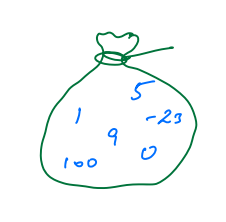
This bag has unique elements, which means every number appears once only.
If we want to add 9 in a bag, then it will be not inserted as the bag already has 9.
Some other examples which contain unique elements are:
- Email-id
- username
- Fingerprints
## Example 2
Let us assume we have an array `arr = [1, 3, -2, 7, 1, 1, -2]`
Now if we want to create a HashSet of it then it contains unique elements.
`HS = [1, 7, -2, 3]`
Here we can see that **hashset does not have any sequence of elements.**
## Syntax
```java
HashSet<Type> hs = new HashSet<Type>();
```
Here Type can be any class
## Basic Operations
We can perform the following operations on HashSet.
- **Add:** Used to add element in HashSet.
- **Contains** Used to check whether HashSet contains a certain element or not.
- Size
- Remove
- **Print:** We use each loop for printing the elements of HashSet
---
### Question
For the given HashSet hs, what will be the size after the following operations?
```
HashSet<Integer> hs = new HashSet<Integer>();
hs.add(3);
hs.add(-2);
hs.add(10);
hs.add(3);
hs.add(10);
hs.add(0);
```
**Choices**
- [ ] 2
- [ ] 3
- [ ] 5
- [x] 4
**Explanation**
```plaintext
The unique elements added to the HashSet are: 3, -2, 10, 0.
So, the size of the HashSet is 4.
```
**Example**
```java
import java.util.*;
import java.lang.*;
class Main{
public static void main(String args[]){
HashSet<Integer> hs = new HashSet<Integer>();
//printing HashSet
System.out.println(hs);
// add
hs.add(3);
hs.add(-2);
hs.add(10);
hs.add(3);
hs.add(10);
hs.add(0);
System.out.println(hs);
// Contains
System.out.println(hs.contains(3));
System.out.println(hs.contains(-1));
// Size
System.out.println("Size is: " + hs.size());
// Remove
hs.remove(3);
System.out.println(hs);
// print
for(Integer i : hs){ // for each loop
System.out.println(i);
}
}
}
```
**Output:**
```plaintext
[]
[0, -2, 3, 10]
true
false
Size is: 4
[0, -2, 10]
```
---
## ArrayList HashSet
## ArrayList
- Sequential order.
- Duplicates allowed
## HashSet
- Sequence not maintained
- Unique element present only.
---
## Problem Statement
Given an integer array as input, add its elements to a HashSet and return the HashSet.
## PseudoCode
```java
import java.util.*;
import java.lang.*;
class Main{
public static HashSet<Integer> convertToHashset(int[] arr){
HashSet<Integer> ans = new HashSet<Integer>();
for(int i = 0; i < arr.length; i++){
ans.add(arr[i]);
}
return ans;
}
public static void main(String args[]){
int arr[] = {1, 4, 3, -2, 1, 1, 4, 5, 3};
System.out.println(convertToHashset(arr));
}
}
```
**Output:**
```plaintext
[1, -2, 3, 4, 5]
```
---
## Problem Statement
Given 2 HashSet as input, print their common elements.
## Example
**Input:**
HS1: {0, -2, 4, 10}
HS2: {1, -2, 3, 4, 5}
**Output:** -2 3
## Understanding the problem
We have to print the elements that are present in both the HashSet.
## PseudoCode
```java
import java.util.*;
import java.lang.*;
class Main{
public static void intersect(HashSet<Integer> hs1, HashSet<Integer> hs2){
for(Integer i : hs1){
if(hs2.contains(i)){
System.out.print(i + " ");
}
}
}
public static HashSet<Integer> convertToHashset(int[] arr){
HashSet<Integer> ans = new HashSet<Integer>();
for(int i = 0; i < arr.length; i++){
ans.add(arr[i]);
}
return ans;
}
public static void main(String args[]){
int arr[] = {1, 4, 3, -2, 1, 1, 4, 5, 3};
HashSet<Integer> hs1 = convertToHashset(arr);
System.out.println(hs1);
int arr2[] = {0, -2, 3, 10};
HashSet<Integer> hs2 = convertToHashset(arr2);
System.out.println(hs2);
intersect(hs1, hs2);
}
}
```
**Output:**
```plaintext
[1, -2, 3, 4, 5]
[0, -2, 3, 10]
-2 3
````
---
### Question
What operation is used to remove an element from a HashSet?
**Choices**
- [ ] Add
- [ ] Size
- [x] Remove
- [ ] Contain
**Explanation**
```plaintext
The `Remove` operation is used to remove an element from a HashSet.
```
---
## HashMap
HashMap is a data structure which contains key-value pairs.
## Example
Let us suppose we have states and its population.
| States | Population |
|:-------:|:----------:|
| Punjab | 15 |
| Haryana | 18 |
| UP | 20 |
| Delhi | 18 |
Now if we have the above data, and our question is to tell the population of UP, then we can simply tell the value next to UP(20).
Here we can say UP->20 is a pair, where UP is a key, corresponding to which some values are stored, and by this key, we access the data.
Here states are key and population are values.
| States(key) | Population(value) |
|:-----------:|:-----------------:|
| Punjab | 15 |
| Haryana | 18 |
| UP | 20 |
| Delhi | 18 |
Some other examples are:
- User id -> password
- Word -> Meaning (dictionary)
## Features of HashMap
- Duplicate values are allowed
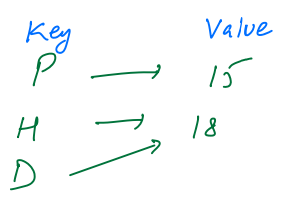
- Duplicate keys are not allowed.
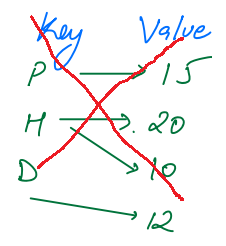
- No order of data, key-value pairs are in random order.
## Syntax
```java
HashMap<keyType, valueType> hm = new HashMap<keyType, valueType>();
```
## Basic Operations
We can perform the following operations on HashMap.
- Add
- Contains
- Get
- Update
- Size
- Remove
- Print
### Example
```java
import java.util.*;
import java.lang.*;
class Main{
public static void main(String args[]){
HashMap<String, Integer> hm = new HashMap<String, Integer>();
// add
hm.put("Delhi", 18);
hm.put("Punjab", 20);
hm.put("Haryana", 18);
hm.put("Goa", 5);
System.out.println(hm);
// Contains
System.out.println(hm.containsKey("Gujarat"));
System.out.println(hm.containsKey("Goa"));
// Get
System.out.println(hm.get("Gujarat"));
System.out.println(hm.get("Goa"));
// Update
hm.put("Goa", 6);
System.out.println(hm);
// Size
System.out.println("Size is: " + hm.size());
// Remove
hm.remove("Goa");
System.out.println(hm);
// print
// 1. get all keys
// hm.keySet()-> returns a set of keys of HashMap
// 2. Use keys to iterate over the map
for(String state : hm.keySet()){
System.out.println(state + " -> " + hm.get(state));
}
}
}
```
**Output:**
```plaintext
{Delhi = 18, Haryana = 18, Goa = 5, Punjab = 20}
false
true
null
5
{Delhi = 18, Haryana = 18, Goa = 6, Punjab = 20}
Size is: 4
{Delhi = 18, Haryana = 18, Punjab = 20}
Delhi -> 18
Haryana -> 18
Punjab -> 20
```
---
### Question
In a HashMap, what is the purpose of the get operation?
**Choices**
- [ ] Add a key-value pair
- [x] Retrieve the value associated with a key
- [ ] Check if a key is present
- [ ] Remove a key-value pair
**Explanation**
```plaintext
The `get` operation in HashMap is used to retrieve the value associated with a given key.
```
---
## Problem Statement
Given an integer array as input, return the corresponding frequency map.
## Example
**Input:**
arr = [1, 4, 3, -2, 1, 1, 4, 5, 3]
**Output:**
```plaintext
hm = {
1: 3,
4: 2,
3: 2,
-2: 1,
5: 1
}
```
## Solution
In this, we iterate over every element of an array, for every element we have two possibilities.
1. Current element is not in the hashmap(`hm.containsKey(arr[i]) == false`).
then add the current element into HashMap with frequency 1.
2. The current element is already present in the HashMap as a key and has some value.
then simply increase the previously stored frequency of the current element by 1.
## PseudoCode
```java
import java.util.*;
import java.lang.*;
class Main{
public static HashMap<Integer, Integer> freqMap(int arr[]){
HashMap<Integer, Integer> hm = new HashMap<Integer, Integer>();
for(int i = 0; i < arr.length; i++){
// case 1 - arr[i] not present in hashmap
if(hm.containsKey(arr[i]) == false){
hm.put(arr[i],1);
}
// case - arr[i] already present in hashmap
// before current element, hm -> {2: 3}
// current -> 2
// hm -> {2: 3}
else{
int beforeValue = hm.get(arr[i]);
int newValue = beforeValue + 1;
hm.put(arr[i], newValue);
}
}
return hm;
}
public static void main(String args[]){
int arr[] = {1, 4, 3, -2, 1, 1, 4, 5, 3};
System.out.println(freqMap(arr));
}
}
```
**Output:**
```plaintext
{1 = 3, -2 = 1, 3 = 2, 4 = 2, 5 = 1}
````
## DryRun
**Input:**
arr[] = {1, 4, 3, -2, 1, 1, 4, 5, 3}
**Solution:**
1. Initially our hashmap is empty, `hm = {}`,
2. Now we start iterating array elements, first element is 1, it is not in HashMap so if the condition becomes true, then we will simply put this element in the map with frequency 1. `hm = {1: 1}`.
3. Next element is 4, it is also not in HashMap so if the condition becomes true, then we will simply put this element in the map with frequency 1. `hm = {1: 1, 4: 1}`.
4. Next element is 3, it is also not in HashMap so if the condition becomes true, then we will simply put this element in the map with frequency 1. `hm = {1: 1, 4: 1, 3: 1}`.
5. Next element is -2, it is also not in HashMap so if the condition becomes true, then we will simply put this element in the map with frequency 1. `hm = {1: 1, 4: 1, 3: 1, -2: 1}`.
6. The next element is 1, it is available in HashMap, so if the condition becomes false, we will go to the else part.
```java
beforeValue = hm.get(1) = 1
newValue = beforeValue + 1 = 1 + 1 = 2
hm.put(1, 2)
```
then hashmap becomes, `hm = {1: 2, 4: 1, 3: 1, -2: 1}`.
7. The next element is again 1, it is available in HashMap, so if the condition becomes false, we will go to the else part.
```java
beforeValue = hm.get(1) = 2
newValue = beforeValue + 1 = 2 + 1 = 3
hm.put(1, 3)
```
then hashmap becomes, `hm = {1: 3, 4: 1, 3: 1, -2: 1}`.
8. The next element is 4, it is available in HashMap, so if the condition becomes false, we will go to the else part.
```java
beforeValue = hm.get(4) = 1
newValue = beforeValue + 1 = 1 + 1 = 2
hm.put(4, 2)
```
then hashmap becomes, `hm = {1: 3, 4: 2, 3: 1, -2: 1}`.
9. Next element is 5, it is also not in HashMap so if the condition becomes true, then we will simply put this element in the map with frequency 1. `hm = {1: 3, 4: 2, 3: 1, -2: 1, 5: 1}`.
10. The next element is 3, it is available in HashMap, so if the condition becomes false, we will go to the else part.
```java
beforeValue = hm.get(3) = 1
newValue = beforeValue + 1 = 1 + 1 = 2
hm.put(3, 2)
```
then hashmap becomes, `hm = {1: 3, 4: 2, 3: 2, -2: 1, 5: 1}`.
 Sign in with Wallet
Connect another wallet
Sign in with Wallet
Connect another wallet