# Refresher: Iteration 2
# Introduction
---
### Recap
* introduction to loop
* while, while else
* break and continue
* print 1 to n, n to 1
* print even numbers, sum
* prime numbers
* scrapers and scissors
---
### Question
What is the output of the following?
```python
count = 0
while(count < 10):
print(10, end = ' ')
count += 1
```
**Choices**
- [ ] 0 1 2 3 4 5 6 7 8 9
- [x] 10 10 10 10 10 10 10 10 10 10
- [ ] Infinite Loop
---
### Question
Which is true for an Odd number n?
**Choices**
- [ ] n % 2 == 0
- [x] n % 2 = = 1
---
### Question
What operation can be used to get the last digit of a number?
**Choices**
- [ ] n - 10
- [ ] n // 10
- [ ] int(n / 10)
- [x] n % 10
---
### Question
What will be the output of the following?
```python
count = 1
while(count <= 5):
if(count == 2):
break
print(count, end = ' ')
count += 1
```
**Choices**
- [ ] 1 3 4 5
- [x] 1
- [ ] 1 2
- [ ] 0 1
---
## Range Function
1. `range(n)` returns number from 0 to n-1.
* start = 0
* jump = 1
* number line example
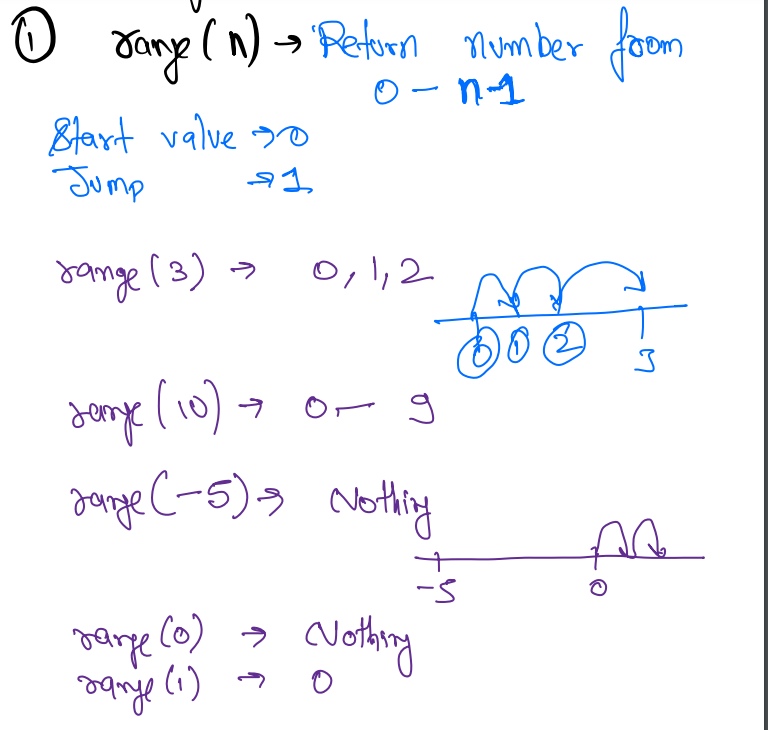
* range(-5) -> nothing as decrementing -5 we will never reach anywhere.
* range(1) -> 0
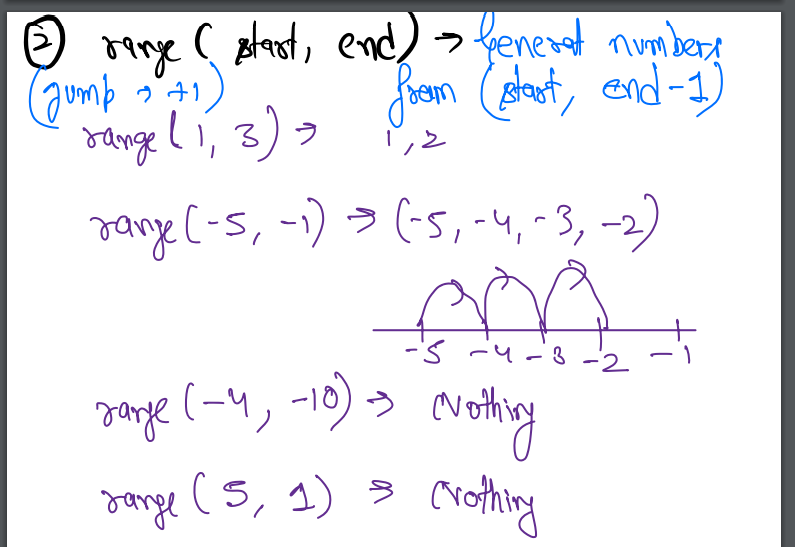
2. range(start, end) -> general numbers from [start, end-1]
* jump -> +1
* range(1,3) -> 1,2
* range(-5, -1) -> -5, -4, -3, -2
* range(-4, -10) -> nothing
* range(5, 1) -> nothing
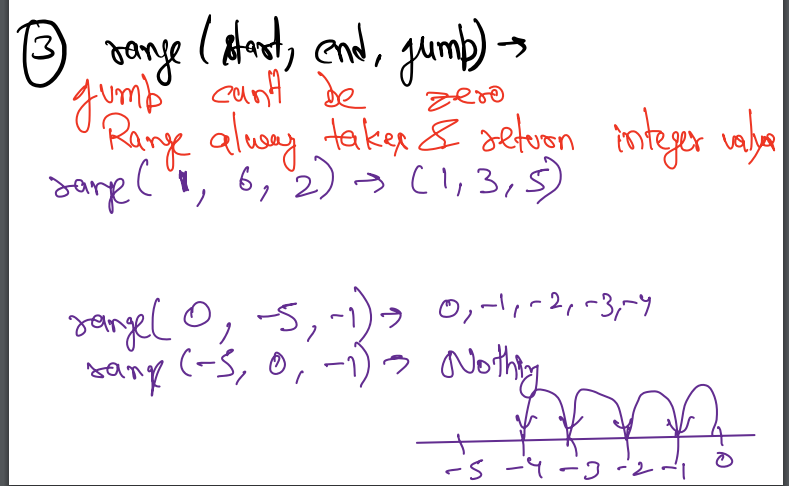
3. range(start, end, jump)
* start, end - 1
* range(1,6,2) -> 1, 3, 5
* range(0, -5, -1) -> 0, -1, -2, -3, -4
### Precautions
* jump can not be zero
* range always takes and returns an integer value
---
## Iterables an Iterators
* Assume that we have a bag of candies. I put my hand in the bag and take the candies out of the back one by one.
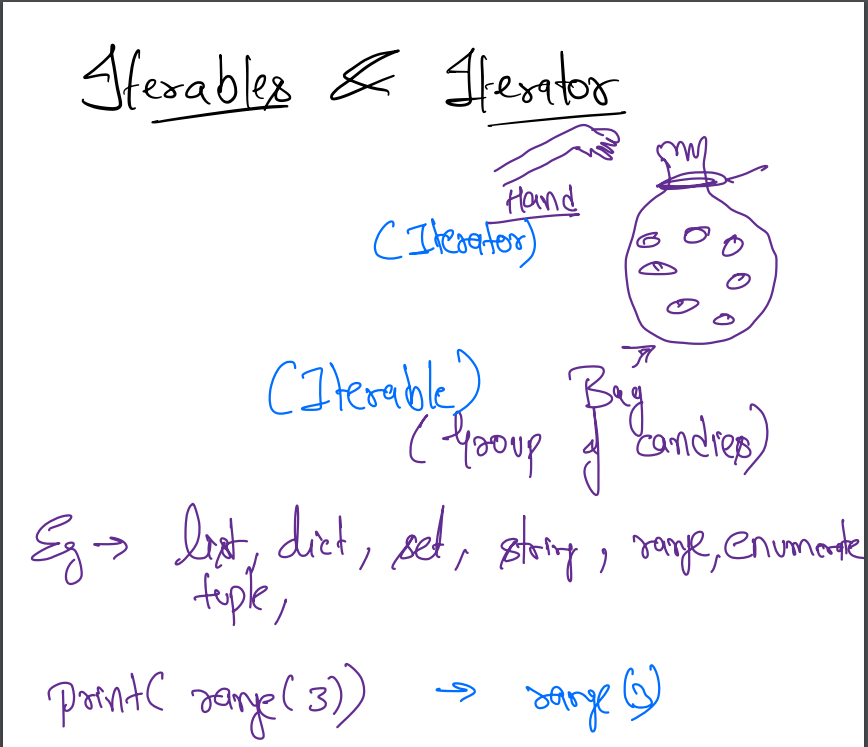
* Examples - list, dict, set, string, range, enumerate, tuple
* Iterables are groups of objects
* Iterator can be related to the hand that we are using to take candies out of the iterables(bag of candies).
### Range as an Iterable
* Range is iterable, it is a collection of integers. If the range returns nothing we can say the bag is empty it doesn't return anything.
`print(range(3))` What will this return?
* Print is not an iterator it will simply return `range(3)`.
* for loop is one of the best iterators.
---
## For Loop
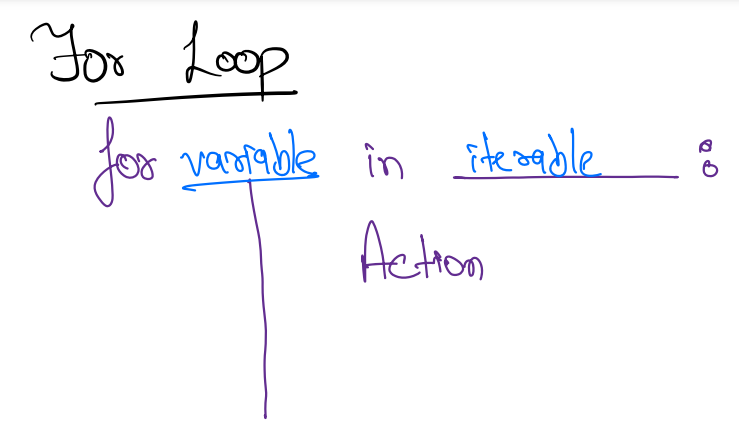
**Syntax:**
```python
for variable in iterable:
action
```
* With for loop we can skip initialization, condition, and updation.
* It is an alternative to the `foreach` loop.
* The for loop can be used with iterables such as lists, dictionaries, etc. This will be covered when we will discuss lists and other iterables.
### Question - Print 1 to 100?
```python
for i in range(1, 101):
print(i)
```
---
### Question
What will the sequence be generated by the following?
```python
range(5)
```
**Choices**
- [ ] 1 2 3 4 5
- [ ] 0 1 2 3 4 5
- [ ] 1 2 3 4
- [x] 0 1 2 3 4
---
### Question
What will the sequence be generated by the following?
```python
range(5,15, 2)
```
**Choices**
- [ ] 5,6,7,8,9,10,11,12,13,14,15
- [ ] 5,7,9,11,13,15
- [x] 5,7,9,11,13
- [ ] 5,6,7,8,9,10,11,12,13,14
---
### Question
What will the sequence be generated by the following?
```python
range(-5,0,1)
```
**Choices**
- [ ] -5,-4,-3,-2,-1,0
- [ ] Nothing
- [ ] 0,-1,-2,-3,-4,-5
- [x] -5,-4,-3,-2,-1
---
### Question
What will the sequence be generated by the following?
```python
range(-10,-5,-1)
```
**Choices**
- [ ] -10,-9,-8,-7,-6,-5
- [ ] -10,-9,-8,-7,-6
- [x] Nothing
- [ ] -6,-7,-8,-9,-10
---
### Question
What is the output of the following?
```python
for i in range(0,1):
print('Hello')
```
**Choices**
- [ ] Hello
Hello
- [ ] Hello
- [x] Nothing
- [ ] 0
1
How many values will be returned by this:
```python
range(n) -> n
```
If you want the loop to run `n` times just say range(n). The loop will run `n` times but start with zero till `n-1` therefore `n` values.
```python
range(5) -> 0, 1, 2, 3, 4 => 5 values
```
---
## Break and Continue in For Loop
* Break and Continue is same as we saw in while loop.
* If you want to break out of the loop if a certain condition is met then you use break. It will break the entire loop and execute the next statement.
* It skips the inside loop and continues the loop’s execution.
**[ASK THE LEARNERS]**
is `_`(underscore) a valid variable name?
* Variable should start with an alphabet or an `_`
* can only have underscore, alphabets, and numbers.
* It should not start with a number.
* Many programmers use underscore when they don't need a name for a variable in the for loop.
```python
for _ in range(10):
print("hello")
```
* If we use `_` it won't give a warning in case we are not using it. With any other variable name, it will give a warning in Python.
* What will be the output of the following:
```python
for i in range(10):
if(i == 4):
break
print(i)
```
**Output:**
```plaintext
0
1
2
3
```
* What will be the output of the following:
```python
for i in range(6):
if(i % 2 == 0):
continue
print(i)
```
**Output:**
```plaintext
1
3
5
```
---
## Pass Statement
* It is not to be used in competitive programming or interviews. It is usually used in testing.
* The `pass` does nothing. It signifies that the programmer will later add some code to it. Right now ignore this block.
```python
for i in range(6):
if(i % 2 == 0):
pass
print(i)
```
* Pass will still print the `i`. In case of continuing it will directly begin with a new iteration.
---
## For Else Loop
* Else statement will execute if the loop terminates successfully i.e. without a break
* Write a code for the prime number in the for loop.
```python
n = int(input())
for i in range(2,n):
if(n % i == 0):
print("Not Prime")
break
else:
print("Prime")
```
---
### Question
What is the output of the following?
```python
for i in range(0,10):
if(i % 3 == 0):
continue
print(i, end = ' ')
```
**Choices**
- [ ] 0 1 2 3 4 5 6 7 8 9
- [ ] 0 1 2
- [ ] 0 1 2 4 5 7 8 9
- [x] 0 1 2 4 5 7 8
---
### Question
What is the output of the following?
```python
for i in range(1,10):
if(i % 3 == 0):
break
print(i, end = ' ')
```
**Choices**
- [ ] 1 2 3 4 5 6 7 8 9
- [x] 1 2
- [ ] 1 2 4 5 7 8 9
- [ ] 1 2 4 5 6 7 8
---
## Nested Loops
* If we write a loop inside a loop it is a nested loop.
* Look at the pattern below and write a code to generate this pattern.
```plaintext
1 2 3 4 5
1 2 3 4 5
1 2 3 4 5
1 2 3 4 5
```
If I want to print `1 to 5`, how will I write the code?
```python
for i in range(1,6):
print(1, end = " ")
```
Now if I want to do this 5 times will I do this?
```python
for i in range(1,6):
print(1, end = " ")
print()
for i in range(1,6):
print(1, end = " ")
print()
for i in range(1,6):
print(1, end = " ")
print()
for i in range(1,6):
print(1, end = " ")
print()
for i in range(1,6):
print(1, end = " ")
print()
```
* No right? What principle it is not following?
* DRY (Do not repeat yourself).
* I will use a nested loop.
```python
for _ in range(5):
for i in range(1,6):
print(1, end = " ")
print()
```
* Single for loop gives 1D data, 2 loops nested will give 2D, and so on.
* Similarly we can write nested while loop
---
## Difference b/w For and While Loop
| For | While |
| :------------------------------------------------------------------------------: | :--------------: |
| It is simple to use. Initialization, condition, and updation in a single line. | Complex to use |
| Only for simple iteration | Complex tasks such as scrapper and Scissors can be performed |
**Note:** Never update the iteration variable in the for loop.
---
## Pattern Printing Problems
```plaintext
* * * * *
* * * * *
* * * * *
* * * * *
* * * * *
```
Write a code to print this pattern.
:::warning
Please take some time to think about the solution on your own before reading further.....
:::
**Solution 1**
```python
for i in range(5):
for j in range(5):
print("*", end = " ")
print()
```
**Solution 2**
We are using string to integer multiplication. The statement `print("* "*5)` will generate a line with 5 stars and a space in between.
```python
for _ in range(5):
print("* " * 5)
```
### Staircase Binding
```plaintext
*
* *
* * *
* * * *
* * * * *
```
:::warning
Please take some time to think about the solution on your own before reading further.....
:::
**Solution 1**
When `i` is `1` we print `1` star, when `i` is `2` we print `2` star, and so on.
```python
n = int(input())
for i in range(1, n + 1):
print("* " * i)
```
**Solution 2**
We can do it with the nested loop as well
```python
for i in range(1, n + 1):
for j in range(i):
print("*", end = " ")
print()
```
### Reverse Staircase
```python
*
* *
* * *
* * * *
* * * * *
```
* Can you guys do it or should I give you a hint?
**No spaces between stars**
* Assuming that there is no space between starts. What we are doing is `4 spaces 1 star`, `3 spaces 2 stars`, `2 spaces 3 stars` and so on.
```python
for i in range(1,6):
spaces = " " * (n - i)
stars = "*" * (i)
print(spaces + stars)
```
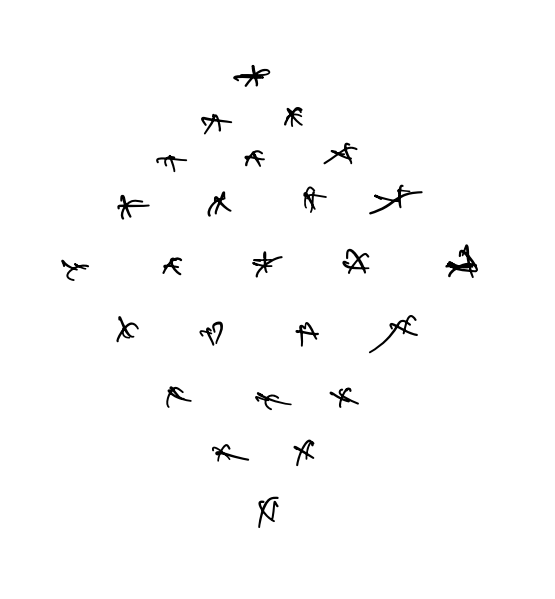
### Homework Problem
 Sign in with Wallet
Connect another wallet
Sign in with Wallet
Connect another wallet