---
# System prepended metadata
title: LC 235. Lowest Common Ancestor of a Binary Search Tree
tags: [medium, leedcode, c++]
---
# LC 235. Lowest Common Ancestor of a Binary Search Tree
### [Problem link](https://leetcode.com/problems/lowest-common-ancestor-of-a-binary-search-tree/)
###### tags: `leedcode` `medium` `c++`
Given a binary search tree (BST), find the lowest common ancestor (LCA) node of two given nodes in the BST.
According to the definition of LCA on Wikipedia: “The lowest common ancestor is defined between two nodes p and q as the lowest node in T that has both p and q as descendants (where we allow **a node to be a descendant of itself** ).”
**Example 1:**
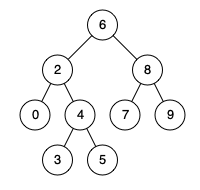 ```
Input: root = [6,2,8,0,4,7,9,null,null,3,5], p = 2, q = 8
Output: 6
Explanation: The LCA of nodes 2 and 8 is 6.
```
**Example 2:**
```
Input: root = [6,2,8,0,4,7,9,null,null,3,5], p = 2, q = 4
Output: 2
Explanation: The LCA of nodes 2 and 4 is 2, since a node can be a descendant of itself according to the LCA definition.
```
**Example 3:**
```
Input: root = [2,1], p = 2, q = 1
Output: 2
```
**Constraints:**
- The number of nodes in the tree is in the range
```
Input: root = [6,2,8,0,4,7,9,null,null,3,5], p = 2, q = 8
Output: 6
Explanation: The LCA of nodes 2 and 8 is 6.
```
**Example 2:**
```
Input: root = [6,2,8,0,4,7,9,null,null,3,5], p = 2, q = 4
Output: 2
Explanation: The LCA of nodes 2 and 4 is 2, since a node can be a descendant of itself according to the LCA definition.
```
**Example 3:**
```
Input: root = [2,1], p = 2, q = 1
Output: 2
```
**Constraints:**
- The number of nodes in the tree is in the range [2, 105].
- -109 <= Node.val <= 109
- All Node.val are **unique** .
- p != q
- p and q will exist in the BST.
## Solution 1
#### C++
```cpp=
class Solution {
public:
TreeNode* lowestCommonAncestor(TreeNode* root, TreeNode* p, TreeNode* q) {
while (root != nullptr) {
if (root->val > p->val && root->val > q->val) {
root = root->left;
} else if (root->val < p->val && root->val < q->val) {
root = root->right;
} else {
return root;
}
}
return nullptr;
}
};
```
## Solution 2
#### C++
```cpp=
/**
* Definition for a binary tree node.
* struct TreeNode {
* int val;
* TreeNode *left;
* TreeNode *right;
* TreeNode(int x) : val(x), left(NULL), right(NULL) {}
* };
*/
class Solution {
public:
TreeNode* lowestCommonAncestor(TreeNode* root, TreeNode* p, TreeNode* q) {
int val = root->val;
if (p->val < val && q->val < val) {
return lowestCommonAncestor(root->left, p, q);
}
if (p->val > val && q->val > val) {
return lowestCommonAncestor(root->right, p, q);
}
return root;
}
};
```
>### Complexity
>| | Time Complexity | Space Complexity |
>| ----------- | --------------- | ---------------- |
>| Solution 1 | O(n) | O(n) |
>| Solution 2 | O(n) | O(n) |
## Note
sol1, 2:
[Ref (0x3F)](https://www.bilibili.com/video/BV1W44y1Z7AR/?spm_id_from=333.788&vd_source=088937f16fb413336c0cb260ed86a1c3)
