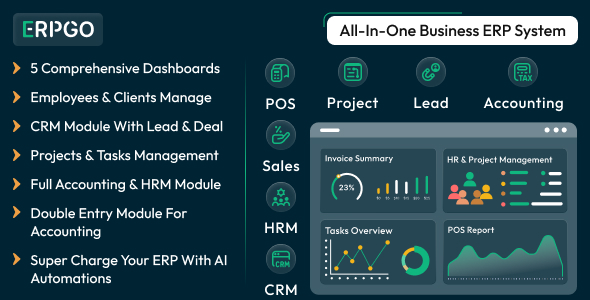
The pursuit of a singular, comprehensive platform to manage an entire business operation is a common objective for organizations of all sizes. Eliminating fragmented systems, reducing data silos, and streamlining workflows are tangible benefits that promise efficiency and improved decision-making. Today, we're taking a detailed look at one such contender in this space: ERPGo - All-In-One Business ERP System. Marketed as a holistic solution, ERPGo aims to consolidate various critical business functions under a single roof. As a technical journalist and a senior web developer, my objective is to dissect its architecture, evaluate its features from a developer's and user's perspective, and provide a clear installation pathway, offering a pragmatic assessment of its capabilities and potential pitfalls.
ERPGo positions itself as an integrated suite covering a broad spectrum of business needs. The core modules typically encompass:
The allure of such a system is undeniable: a unified interface, shared data, and reduced integration headaches. However, the true test lies in the depth and robustness of each module, and how seamlessly they interoperate without becoming a jack-of-all-trades, master of none.
Typically, an application claiming such extensive functionality relies on a mature, well-understood web stack. ERPGo, like many modern PHP applications, is built on the Laravel framework, leveraging MySQL as its database backend. This choice presents both advantages and potential challenges.
Laravel provides a solid foundation for rapid development, offering ORM capabilities (Eloquent), a robust routing system, and an MVC architecture that promotes separation of concerns. This means that, from a maintainability standpoint, developers familiar with Laravel should find the codebase relatively approachable for customization or extension. The use of MySQL is standard for many web applications, offering reliability and good performance for typical transactional workloads. However, the sheer volume of data an "all-in-one" ERP generates, especially for larger organizations, necessitates careful attention to database indexing, query optimization, and potentially, scaling strategies beyond a single MySQL instance.
The database design itself becomes critical. A single, monolithic database can simplify initial setup but can become a bottleneck for performance and data integrity if not meticulously structured. Cross-module queries, essential for an integrated system, must be efficient. As a developer, I'd scrutinize the foreign key relationships, the use of appropriate data types, and the existence of composite indexes for frequently joined tables. Poorly designed tables or missing indexes can quickly lead to slow report generation and unresponsive interfaces as the dataset grows.
On the frontend, ERPGo employs a modern, responsive design. While the specific JavaScript framework might vary (often Vue.js or a lightweight alternative is common in Laravel ecosystems), the user interface needs to be intuitive, especially given the breadth of features. A cluttered or inconsistent UI can quickly diminish the value of even the most powerful backend. The responsiveness across devices is a prerequisite, not a luxury, for today's business applications.
The "all-in-one" moniker often implies a certain compromise. While ERPGo integrates many functions, the critical question is whether each module is sufficiently powerful for serious business use. We'll examine some key areas:
CRM & Sales: For basic lead tracking, client management, and proposal generation, ERPGo often provides a respectable toolkit. You can typically manage contacts, track communication, and generate proposals. However, for organizations with complex sales pipelines, intricate pricing models, or advanced sales forecasting requirements, a dedicated, high-end CRM might offer more granular control and deeper analytics. Integration with external sales tools (e.g., email marketing platforms) is crucial but often requires custom development or specific add-ons.
HRM: Core HRM features like employee directories, attendance, and leave management are usually present and functional. The depth of payroll functionality, however, is a common differentiator. Many general ERPs either offer a basic payroll system that requires significant manual input for tax and compliance, or they provide integration points with specialized payroll services. For complex labor laws, benefits administration, or advanced performance review cycles, a dedicated HRM solution often excels. ERPGo likely caters to simpler HRM needs, which is suitable for many SMBs.
Financial Management: A robust accounting module is the backbone of any ERP. ERPGo usually includes general ledger, accounts payable/receivable, invoicing, expense tracking, and basic budgeting. The critical aspect here is compliance with accounting standards (e.g., GAAP, IFRS) and the ability to generate essential financial reports like balance sheets, profit and loss statements, and cash flow reports. While ERPGo provides these, businesses with complex multi-currency operations, advanced cost accounting, or stringent audit requirements might find the feature set somewhat basic, necessitating custom reports or supplementary software.
Project Management: This module is often well-developed in ERPGo, offering features like task creation, assignment, time tracking, dependency management, and perhaps Kanban boards or Gantt charts. For teams needing straightforward project organization and collaboration within the ERP ecosystem, it's effective. However, it typically won't replace specialized project management platforms (like Jira or Asana) for agile teams requiring intricate workflows, advanced issue tracking, or deep integration with CI/CD pipelines.
Inventory & Procurement: Managing products, tracking stock levels, handling purchase orders, and managing vendors are fundamental. ERPGo's inventory module aims to cover these. The challenge for any integrated system is handling complex inventory scenarios: multiple warehouses, batch tracking, serial numbers, reorder points, or sophisticated demand forecasting. For businesses with intricate supply chains or manufacturing operations, the inventory features might require significant customization or fall short of dedicated Warehouse Management Systems (WMS).
Reporting & Analytics: The ability to extract meaningful insights from aggregated data is where an ERP truly shines. ERPGo typically provides various pre-built reports and customizable dashboards. The value here depends heavily on the flexibility of the reporting engine. Can users create ad-hoc reports without developer intervention? Are there good visualization options? For deep business intelligence or predictive analytics, integration with dedicated BI tools might be necessary, as native ERP reporting, while functional, often has limitations in advanced statistical analysis or large-scale data warehousing.
Any "all-in-one" system carries inherent performance and scalability challenges. A single application handling CRM, HRM, accounting, and project management means high database activity and potentially complex queries. Without careful optimization, performance can degrade quickly as the number of users and data records grows. Server specifications become crucial; a simple shared hosting environment will quickly be overwhelmed. A dedicated VPS or cloud instance with sufficient RAM, CPU cores, and fast I/O storage (SSD preferred) is a baseline requirement. Caching mechanisms (e.g., Redis for Laravel) and well-tuned database servers are vital to ensure responsiveness.
From a security standpoint, as with any web application, adherence to best practices is paramount. ERPGo, being built on Laravel, benefits from the framework's inherent security features (CSRF protection, SQL injection prevention via Eloquent, XSS protection with blade templating). However, the implementation details matter. Secure user authentication, granular role-based access control (RBAC), and protection against common vulnerabilities like mass assignment or insecure direct object references must be robust. Data encryption, both at rest and in transit (SSL/TLS), is non-negotiable for an ERP handling sensitive business data. Regular security audits and prompt application of patches are essential maintenance tasks for any deployment.
No off-the-shelf ERP perfectly fits every business process. The ability to customize and extend ERPGo is a critical factor for long-term viability. As a Laravel application, developers can leverage its extensibility points. This usually means:
The ease of customization directly impacts the total cost of ownership. While ERPGo offers a foundation, budgeting for developer time to tailor it to specific business nuances is a realistic expectation.
The best features are useless if users struggle to find or operate them. An ERP's UI/UX is paramount for adoption and productivity. ERPGo typically presents a clean, dashboard-driven interface. Key considerations include:
While often aesthetically pleasing, the real test of an ERP's UI/UX comes with sustained, daily use by a diverse user base, ranging from C-suite executives to operational staff.
Given its "all-in-one" nature and typical feature set, ERPGo often finds its sweet spot with Small to Medium-sized Businesses (SMBs) and startups that need a comprehensive system without the prohibitive cost and complexity of enterprise-level solutions like SAP or Oracle. It suits organizations looking to consolidate disparate systems and manage their core operations from a single platform. Companies with straightforward business processes and a willingness to adapt some of their workflows to the system will likely benefit most. For highly specialized industries or very large enterprises with intricate compliance and scaling needs, ERPGo might serve as a strong foundation but will undoubtedly require significant customization and potentially integration with specialized external systems.
Before proceeding with an installation, it's crucial to evaluate if ERPGo aligns with your specific operational needs and future growth trajectory. It's a tool that provides a robust starting point, but like any powerful system, its true value is unlocked through careful configuration, user training, and ongoing maintenance.
Deploying ERPGo requires a standard web server environment. This guide assumes a Linux-based server (Ubuntu/CentOS are common) with Apache or Nginx, PHP, and MySQL. We'll walk through the process step-by-step.
Before you begin, ensure your server meets the following requirements:
php-ctypephp-curlphp-domphp-fileinfophp-gd (or imagemagick)php-jsonphp-mbstringphp-mysqlphp-opensslphp-pdophp-tokenizerphp-xmlphp-zipphp-bcmath (often needed for financial calculations)php-intlInstallation of PHP and Extensions (Ubuntu Example):
sudo apt update
sudo apt install software-properties-common
sudo add-apt-repository ppa:ondrej/php
sudo apt update
sudo apt install php8.1 php8.1-cli php8.1-fpm php8.1-mysql php8.1-curl php8.1-mbstring php8.1-xml php8.1-gd php8.1-bcmath php8.1-zip php8.1-intl php8.1-dom php8.1-fileinfo
Installation of MySQL Server:
sudo apt install mysql-server
sudo mysql_secure_installation
Installation of Composer:
curl -sS https://getcomposer.org/installer | php
sudo mv composer.phar /usr/local/bin/composer
composer --versionFirst, obtain the ERPGo source files. If you've acquired it from a platform like gplpal or a similar GPL-compliant distributor, you'll likely have a ZIP archive. Upload this archive to your server, preferably to a directory like `/var/www/`.
# Create a directory for your ERPGo installation
sudo mkdir -p /var/www/erpgo
cd /var/www/erpgo

# Upload your ERPGo.zip file to this directory using SFTP or SCP.
# Then, unzip it:
sudo unzip ERPGo.zip

# Ensure the 'public' directory exists and is the webroot
# The contents of the zip usually contain the entire Laravel project structure directly.
# So, your project files will be directly in /var/www/erpgoCreate a new MySQL database and a dedicated user for ERPGo. This improves security by limiting privileges.
sudo mysql -u root -p

# Enter your MySQL root password
# Once logged in, execute:
CREATE DATABASE erpgo_db CHARACTER SET utf8mb4 COLLATE utf8mb4_unicode_ci;
CREATE USER 'erpgo_user'@'localhost' IDENTIFIED WITH mysql_native_password BY 'your_strong_password';
GRANT ALL PRIVILEGES ON erpgo_db.* TO 'erpgo_user'@'localhost';
FLUSH PRIVILEGES;
EXIT;
Replace `erpgo_db`, `erpgo_user`, and `your_strong_password` with your desired values.
ERPGo uses Laravel's `.env` file for environment-specific configurations.
cd /var/www/erpgo
sudo cp .env.example .env
Now, open the `.env` file for editing:
sudo nano .envAdjust the following lines:
Save and exit the `.env` file (Ctrl+X, Y, Enter in nano).
With the `.env` file configured, install PHP dependencies and set up the database schema.
cd /var/www/erpgo

# Install Composer dependencies
composer install --no-dev --optimize-autoloader

# Generate application key (if not already done)
php artisan key:generate

# Run database migrations (creates all necessary tables)
php artisan migrate --force

# Seed the database with initial data (e.g., default user, settings)
# Note: Check ERPGo's documentation if there's a specific seed command,
# sometimes it's `php artisan db:seed` or `php artisan db:seed --class=SomeSeeder`
# For ERPGo, it often creates the admin user during the first visit or via an initial setup wizard.
# If unsure, check documentation or proceed without db:seed initially.Laravel needs write access to the `storage` and `bootstrap/cache` directories.
sudo chown -R www-data:www-data /var/www/erpgo
sudo find /var/www/erpgo -type f -exec chmod 664 {} \;
sudo find /var/www/erpgo -type d -exec chmod 775 {} \;
sudo chmod -R 775 /var/www/erpgo/storage
sudo chmod -R 775 /var/www/erpgo/bootstrap/cache
`www-data` is the typical user/group for Apache/Nginx on Ubuntu. Adjust if your server uses a different user (e.g., `nginx` on CentOS for Nginx).
Create a new Apache Virtual Host file for ERPGo.
sudo nano /etc/apache2/sites-available/erpgo.confAdd the following content (adjust `ServerName` and `ErrorLog`/`CustomLog` paths):
    ServerAdmin webmaster@localhost
    ServerName erp.yourdomain.com
    DocumentRoot /var/www/erpgo/public


        Options Indexes FollowSymLinks MultiViews
        AllowOverride All
        Require all granted


    ErrorLog ${APACHE_LOG_DIR}/erpgo_error.log
    CustomLog ${APACHE_LOG_DIR}/erpgo_access.log combined
Save and close the file. Now, enable the virtual host and rewrite module, then restart Apache:
sudo a2ensite erpgo.conf
sudo a2enmod rewrite
sudo systemctl restart apache2
sudo systemctl enable apache2
Nginx Configuration Example:
If you're using Nginx, create a new server block file:
sudo nano /etc/nginx/sites-available/erpgo.confAdd the following content (adjust `server_name`):
server {
    listen 80;
    server_name erp.yourdomain.com;
    root /var/www/erpgo/public;

    add_header X-Frame-Options "SAMEORIGIN";
    add_header X-XSS-Protection "1; mode=block";
    add_header X-Content-Type-Options "nosniff";
    add_header Referrer-Policy "no-referrer-when-downgrade";

    index index.php index.html index.htm;

    charset utf-8;

    location / {
        try_files $uri $uri/ /index.php?$query_string;
    }

    location = /favicon.ico { access_log off; log_not_found off; }
    location = /robots.txt  { access_log off; log_not_found off; }

    error_page 404 /index.php;

    location ~ \.php$ {
        fastcgi_pass unix:/var/run/php/php8.1-fpm.sock; # Adjust PHP-FPM socket if necessary
        fastcgi_index index.php;
        fastcgi_param SCRIPT_FILENAME $realpath_root$fastcgi_script_name;
        include fastcgi_params;
    }

    location ~ /\.(?!well-known).* {
        deny all;
    }
}
Save and close. Link the configuration, test Nginx, and restart:
sudo ln -s /etc/nginx/sites-available/erpgo.conf /etc/nginx/sites-enabled/
sudo nginx -t
sudo systemctl restart nginx
sudo systemctl enable nginx
Ensure `php8.1-fpm` is running for Nginx:
sudo systemctl start php8.1-fpm
sudo systemctl enable php8.1-fpmNow, open your web browser and navigate to the `APP_URL` you configured (e.g., `http://erp.yourdomain.com`).
You should be greeted by the ERPGo installation wizard or login screen. Follow the on-screen instructions, which typically involve creating your administrator account. During this process, it might also run final migrations or seed data.
Crucial Post-Installation Tasks:
sudo crontab -e
# Add the following line at the end
* * * * * cd /var/www/erpgo && php artisan schedule:run >> /dev/null 2>&1Successfully setting up ERPGo lays the groundwork for consolidating your business operations. While the initial installation is straightforward, proper configuration, security hardening, and ongoing maintenance are crucial for maximizing its utility and ensuring reliable performance. For more resources on themes and plugins that complement such a system, you might explore Free download WordPress themes and other GPL resources.